Architecting Scale-Out NAS Storage for High-Concurrency AI Training and Parallel Data Processing Workloads
- Mary J. Williams
- Mar 3
- 4 min read

Artificial intelligence and deep learning models require massive datasets to achieve high levels of accuracy. As these models grow in complexity, the infrastructure supporting them must scale accordingly. Storage architectures often become the primary bottleneck in high-concurrency AI training environments. Compute nodes processing neural networks can easily outpace the storage layer's ability to feed them data, leading to stalled GPU clusters and wasted computational resources.
Addressing this imbalance requires a fundamental shift in how data is stored, accessed, and managed. Traditional storage silos fall short when handling the massive throughput and concurrent read requests generated by parallel data processing algorithms. Building an infrastructure capable of sustaining these demands means adopting a distributed approach.
This post details the technical requirements for designing high-performance storage environments. You will learn how to architect scale out NAS storage to support the intense concurrent demands of modern AI training pipelines, ensuring your compute clusters remain fully utilized.

The I/O Challenge in AI Training
AI training workloads are inherently I/O intensive. During an epoch, training algorithms read millions of small files, such as images, audio clips, or text documents, in a highly randomized pattern. When hundreds or thousands of compute nodes request this data simultaneously, the resulting metadata operations and random read requirements can overwhelm standard storage protocols.
Traditional scale-up NAS systems rely on dual-controller architectures. While these controllers provide redundancy, they create a hard limit on performance. Once the controllers reach their maximum processing capacity, adding more disk shelves only increases capacity, not throughput or IOPS. This architectural limitation forces organizations to partition datasets or invest in inefficient over-provisioning strategies.
Designing Scale Out NAS Storage for Concurrency
To bypass the limitations of legacy hardware, architects must implement scale out NAS storage. This architecture distributes data and I/O operations across a cluster of independent storage nodes. As you add nodes to the cluster, you increase storage capacity, network bandwidth, and computational power simultaneously.
Distributed Metadata Management
A critical component of high-concurrency storage design is metadata management. In AI workloads, metadata operations—such as file lookups, permission checks, and directory listings—can account for more than half of all storage traffic.
Centralized metadata servers quickly become bottlenecks under parallel data processing conditions. Modern scale out NAS storage distributes metadata across all nodes in the cluster. This decentralized approach allows the system to process millions of concurrent file lookups without creating a single point of failure or performance degradation. By hashing metadata across the cluster, the storage infrastructure ensures rapid file access regardless of the dataset's overall size.
Parallel Data Access Protocols
Standard NFS and SMB protocols were designed for sequential access by single clients, making them suboptimal for distributed AI training. To maximize throughput, architects must leverage parallel file system clients or optimized NFS variations like NFSv4.1 with pNFS (Parallel NFS).
These advanced protocols allow compute nodes to communicate directly with the specific storage node holding the required data block. Bypassing a central coordination node drastically reduces latency and maximizes the utilization of available network bandwidth. When implementing NAS systems for AI, ensuring client-side support for parallel data access is mandatory for achieving peak GPU utilization.
Optimizing the Hardware Layer
Software architecture dictates how data is routed, but the underlying hardware dictates the maximum physical speed. High-concurrency AI workloads require specific hardware configurations to prevent micro-stutters and latency spikes during model training.
NVMe and Flash Optimization
Spinning disk drives (HDDs) cannot physically position their read/write heads fast enough to handle the randomized read patterns of deep learning. NVMe (Non-Volatile Memory Express) solid-state drives are required for the performance tier of the storage cluster.
NVMe bypasses the legacy SAS/SATA host bus adapters, connecting directly to the PCIe bus. This direct connection reduces latency to microseconds and supports massive queue depths. When designing NAS systems, utilizing NVMe for the active training datasets ensures that GPUs spend their time processing data rather than waiting for it.
High-Bandwidth Networking
Scale-out architectures rely heavily on the network fabric connecting the storage nodes to the compute clusters. High-performance NAS systems depend on robust, low-latency connectivity, as standard 10GbE or 25GbE networks will quickly saturate under AI training loads.
Deploying 100GbE, 200GbE, or InfiniBand networks is necessary to support the data rates required by modern GPU clusters. Furthermore, implementing technologies like RDMA (Remote Direct Memory Access) allows data to move directly from storage memory to GPU memory, bypassing the CPU overhead on both the storage and compute nodes. This zero-copy data transfer is essential for maintaining low latency at scale.
Managing Data Lifecycles in AI Pipelines
AI datasets are rarely static. Data moves through a pipeline: ingestion, cleaning, training, and archiving. Storing all data on expensive NVMe arrays is not cost-effective. A well-architected storage environment implements intelligent data tiering.
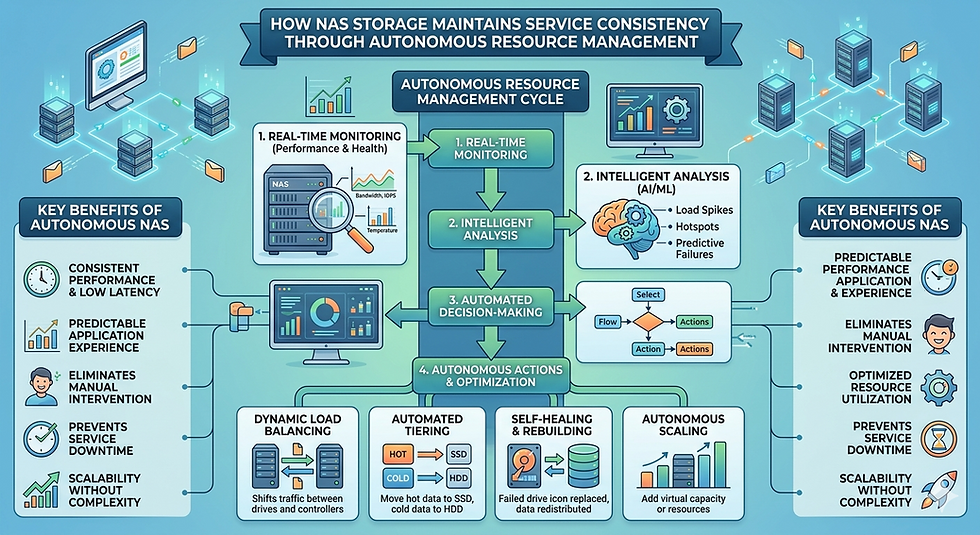
Hot data actively used in training epochs resides on the scale-out NVMe tier. As models mature and datasets age, the storage system should automatically migrate cold data to lower-cost tiers, such as high-capacity HDD clusters or cloud object storage. This automated lifecycle management ensures the high-performance tier remains available for the most demanding concurrent workloads without requiring manual intervention from storage administrators.
Future-Proofing Your AI Infrastructure
Building storage for AI requires anticipating continuous growth in model size and dataset complexity. Relying on legacy dual-controller arrays will result in processing bottlenecks and reduced return on investment for expensive compute hardware.
By implementing scale out NAS storage equipped with distributed metadata management, NVMe flash, and high-bandwidth RDMA networks, organizations can ensure their infrastructure scales linearly. This systematic approach guarantees that storage performance will grow alongside computational capacity, enabling data science teams to train more complex models in a fraction of the time. Review your current I/O metrics and network topology to determine where a distributed scale-out architecture can optimize your AI training pipelines.


Comments