Automating NAS Systems: Leveraging Machine Learning to Predict Storage Hotspots and Prevent Bottlenecks
- Mary J. Williams
- Feb 19
- 5 min read

Network-attached storage (NAS) systems have become the backbone of modern enterprise data management. But as data volumes grow exponentially, even the most robust NAS infrastructure can buckle under pressure. Storage hotspots emerge without warning, performance degrades, and IT teams scramble to address bottlenecks that impact productivity across the organization.
Machine learning offers a way forward. By analyzing usage patterns and predicting demand, ML algorithms can identify potential hotspots before they disrupt operations. This proactive approach transforms how organizations manage their NAS systems, shifting from reactive troubleshooting to intelligent automation.

Understanding storage hotspots in NAS systems
Storage hotspots occur when certain areas of your NAS system experience disproportionately high access rates compared to others. These concentrated bursts of activity create performance bottlenecks that slow down the entire network.
Common causes include:
Unbalanced data distribution: Popular files or datasets cluster in specific locations
Application behavior: Certain applications repeatedly access the same storage areas
User patterns: Teams accessing shared resources during peak hours
Backup operations: Scheduled tasks that overwhelm specific storage nodes
Traditional monitoring tools can detect hotspots after they occur, but by then, users have already experienced slowdowns. The damage to productivity—and user frustration—has been done.
How machine learning predicts storage demand?
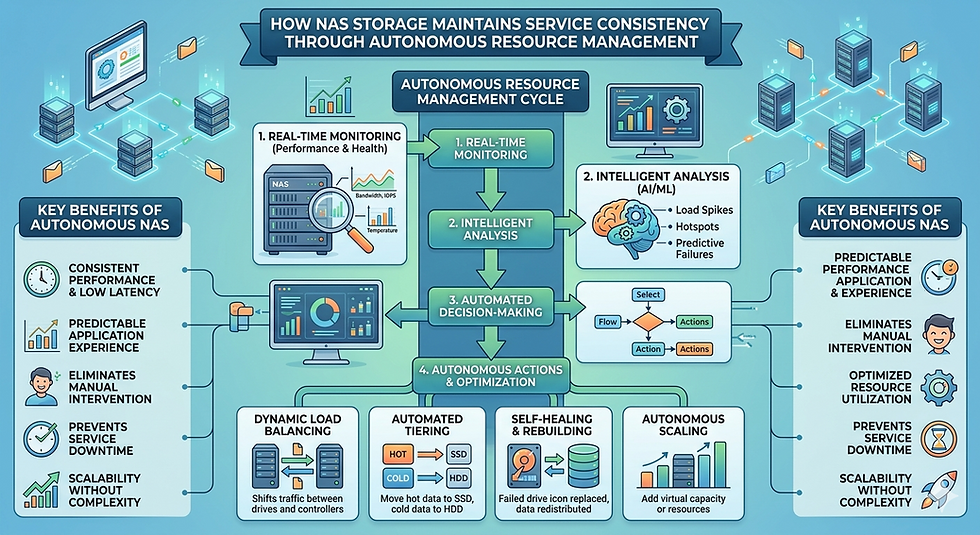
Machine learning algorithms excel at pattern recognition. When applied to NAS systems, they analyze historical access patterns, file metadata, user behavior, and system performance metrics to forecast future storage needs.
The process works in several stages:
Data collection: The ML system continuously gathers metrics including file access frequency, data transfer rates, storage utilization, and user activity patterns. This creates a comprehensive baseline of normal system behavior.
Pattern analysis: Algorithms identify trends and correlations that human administrators might miss. For example, the system might notice that certain file types consistently generate high traffic on specific days or that particular user groups create predictable load patterns.
Predictive modeling: Using techniques like time series analysis and neural networks, the system forecasts where and when storage demand will spike. These predictions become more accurate over time as the model learns from new data.
Automated response: When the system predicts a potential hotspot, it can trigger automated actions such as redistributing data, allocating additional resources, or alerting administrators to take preventive measures.
Scale out NAS storage: The foundation for ML-driven automation
Scale out NAS storage architecture provides the flexibility needed for machine learning automation to work effectively. Unlike traditional NAS systems that rely on a single controller, scale out NAS distributes data across multiple nodes that work together as a unified system.
This architecture offers several advantages:
Horizontal scalability: Add storage capacity and performance simply by adding more nodes to the cluster. The system automatically incorporates new resources without disruption.
Load distribution: Data and workload spread across multiple nodes, reducing the risk of any single point becoming a bottleneck.
Flexibility for automation: ML algorithms can dynamically move data between nodes based on predicted demand, optimizing performance across the entire infrastructure.
When combined with machine learning, scale out NAS storage becomes truly intelligent. The system doesn't just respond to current conditions—it anticipates future needs and adjusts accordingly.
Implementing ML automation in your NAS environment
Getting started with ML-driven NAS automation requires careful planning. Here's a practical roadmap:
Assess your current infrastructure
Begin by evaluating your existing NAS system. Document current performance metrics, identify recurring bottlenecks, and understand your data access patterns. This baseline will help you measure the impact of automation once implemented.
Choose the right ML tools
Several platforms offer machine learning capabilities for storage management. Look for solutions that integrate with your existing NAS infrastructure and provide:
Real-time monitoring and analysis
Customizable predictive models
Automated data migration capabilities
Clear reporting and visualization tools
Start with a pilot program
Rather than automating your entire infrastructure at once, select a specific use case or department. This controlled approach lets you refine your ML models and prove value before expanding.
Train your models
ML algorithms need quality data to make accurate predictions. Allow your system to collect several weeks or months of baseline data before relying on its predictions. The longer the learning period, the more accurate the forecasts.
Set appropriate automation thresholds
Decide which actions the system can take automatically and which require human approval. In a scale-out NAS storage environment, you might allow automatic data redistribution across nodes but require administrator sign-off for adding new storage nodes.
Real-world benefits of predictive NAS management
Organizations that implement ML-driven NAS automation typically see measurable improvements:
Reduced downtime: By addressing potential bottlenecks before they occur, systems maintain consistent performance even during peak usage periods.
Lower infrastructure costs: Predictive analytics help right-size storage investments. You add capacity when truly needed rather than over-provisioning out of caution.
Improved user experience: End users benefit from faster file access and more reliable performance, even as data volumes grow.
Freed IT resources: Administrators spend less time firefighting storage issues and more time on strategic initiatives.
Overcoming implementation challenges
Adopting ML automation isn't without obstacles. Common challenges include:
Data quality concerns: ML models are only as good as the data they're trained on. Ensure your monitoring systems capture accurate, comprehensive metrics.
Integration complexity: Connecting ML tools with existing NAS infrastructure may require custom development or middleware solutions.
Trust in automation: IT teams often hesitate to let algorithms make critical decisions. Build confidence gradually by starting with low-risk automation and expanding as the system proves itself.
Ongoing maintenance: ML models need regular updates and refinement. Budget time for model tuning and retraining as your environment evolves.
The future of intelligent storage management
Machine learning represents just the beginning of truly autonomous storage systems. Emerging technologies promise even greater capabilities:
Advanced algorithms will incorporate broader context, considering factors like business priorities, compliance requirements, and cost optimization when making storage decisions. Integration with other IT systems will create holistic automation that spans the entire infrastructure.
The goal isn't to replace human expertise but to augment it. ML handles the repetitive analysis and routine optimizations while administrators focus on strategic planning and complex problem-solving.
Transform your NAS system from reactive to proactive
Storage bottlenecks don't have to be inevitable. By leveraging machine learning to predict hotspots and automate responses, organizations can maintain optimal NAS performance as data demands grow.
The shift from reactive management to proactive automation requires investment in both technology and mindset. But the payoff—consistent performance, reduced costs, and freed IT resources—makes it worthwhile for any organization serious about managing modern data storage challenges.
Start small, measure results, and expand your automation gradually. Your future self—and your users—will thank you.


Comments