Designing a NAS System to Maintain Stability During High-Frequency ACL Validation Requests
- Mary J. Williams
- Apr 1
- 4 min read

Enterprise storage environments face rigorous performance demands, particularly when managing concurrent user access across extensive directory structures. High-frequency Access Control List (ACL) validation requests represent a distinct architectural challenge. When thousands of users or automated services request file access simultaneously, the underlying storage infrastructure must evaluate permissions against complex directory services like Active Directory or LDAP. This process generates massive metadata overhead.
If the infrastructure is not explicitly designed to handle this metadata surge, the entire storage ecosystem risks severe latency spikes or catastrophic failure. The CPU and memory resources required to resolve deeply nested permissions can easily bottleneck traditional storage controllers. Consequently, standard read and write operations degrade, leading to unacceptable application performance and potential data timeouts.
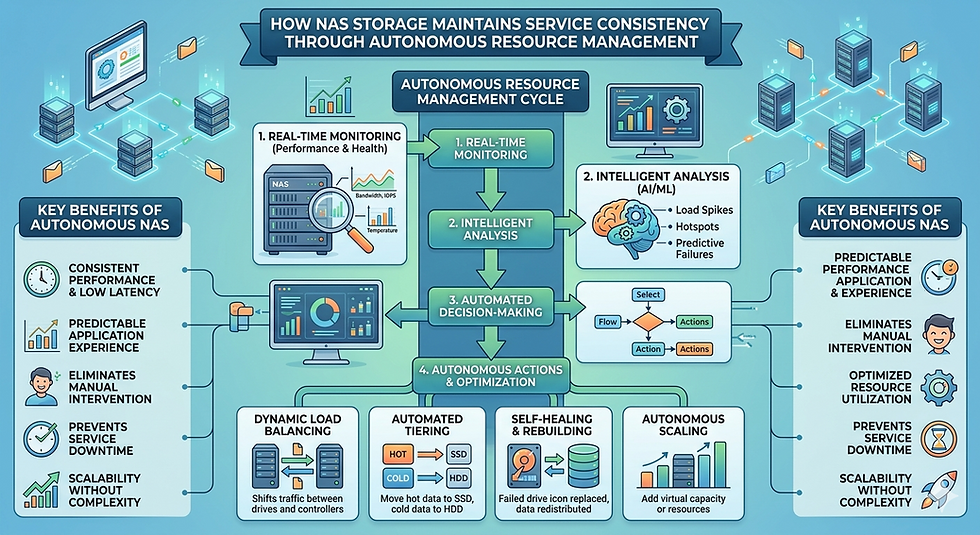
Solving this engineering problem requires a systematic approach to storage architecture. By distributing metadata workloads, implementing aggressive caching algorithms, and choosing the correct hardware topology, storage administrators can maintain peak stability. This guide details the technical requirements for designing a NAS System capable of absorbing massive ACL validation spikes without compromising throughput or reliability.

Understanding the ACL Validation Bottleneck
In a NAS system, every file access request initiates an authorization check. The operating system must read the file's metadata, extract the ACL, and compare the requesting user’s security identifiers against the permitted entries. In heavily restricted environments with deep directory hierarchies, a single read request might trigger multiple ACL checks across parent directories.
When these requests occur at high frequencies—such as during a widespread automated software deployment, a virtual desktop infrastructure (VDI) boot storm, or massive parallel computing workloads—the metadata operations per second (metadata IOPS) scale exponentially. Traditional monolithic storage arrays process these operations through a single set of storage controllers. Once those controllers reach maximum CPU utilization or their memory buffers saturate, they begin queuing requests. This queuing manifests as severe application latency.
Architectural Strategies for Stable File Storage
To mitigate the computational tax of access verification, architects must move away from single-choke-point designs. The solution relies on distributed computing principles and optimized memory management.
Implementing Scale Out NAS
The most effective method for handling high-frequency metadata operations is transitioning to a scale out nas architecture. Unlike scale-up systems that rely on adding disk shelves to a fixed pair of controllers, scale-out systems aggregate the CPU, memory, and network resources of multiple independent nodes into a single, unified cluster.
When a localized storm of ACL requests hits a scale out nas, the cluster distributes the authentication workload across all available nodes. Advanced load-balancing algorithms ensure no single node absorbs the entirety of the directory service queries. As the organization grows and the frequency of access requests increases, administrators can linearly scale metadata performance simply by adding more nodes to the cluster. This distributed approach provides the computational breadth necessary to validate permissions instantly, maintaining low-latency data access for end-users.
Optimizing Metadata Caching
Even within a scale out NAS architecture, querying external directory services for every access request is highly inefficient. System stability requires robust caching mechanisms at the storage layer.
Storage operating systems must be configured to cache ACLs and user credentials aggressively in high-speed RAM or NVMe storage tiers. When a user requests access to a file, the system checks the local metadata cache before querying the external domain controller. A high cache hit ratio drastically reduces the time required for ACL validation and shields the external directory servers from being overwhelmed by the storage array. Administrators must monitor cache eviction rates and allocate sufficient memory to metadata caching to ensure the system remains resilient during usage peaks.
Offloading Authentication Traffic
Network topology plays a critical role in system stability. ACL validation requires constant communication between the NAS controllers and the identity management servers. Mixing this authentication traffic with standard data payload traffic on the same network interfaces can lead to packet collisions and network congestion.
Isolating authentication traffic on dedicated VLANs or physical network interfaces ensures that directory service queries have guaranteed bandwidth. This segregation prevents massive file transfers from choking the communication channels required for permission validation, thereby maintaining predictable response times during access checks.
Securing Data Integrity During Peak Loads
System stability is not solely about maintaining performance; it is also about ensuring data remains protected and recoverable when the system is under extreme stress. High-frequency access patterns often correlate with heightened risks of accidental deletions, rapid malware propagation, or ransomware attacks masquerading as legitimate automated access.
The Role of Immutable Snapshots for NAS
To protect against rapid, unauthorized modifications during peak usage windows, administrators must integrate Immutable Snapshots for NAS into their data protection strategy. Immutable snapshots capture the state of the file system at a specific point in time and lock it at the storage level. Once created, these snapshots cannot be altered, encrypted, or deleted by any user, administrator, or malicious script until a predefined retention period expires.
When a system is processing thousands of ACL validations per second, the risk of a compromised account executing a destructive workload increases. Immutable snapshots provide a guaranteed, unchangeable recovery point. Because they operate at the block level within the storage architecture, generating these snapshots incurs virtually zero performance penalty, allowing them to run concurrently with high-frequency access validations without destabilizing the system.
Designing for Resilience and High Availability
Hardware redundancy remains a foundational requirement for any stable storage deployment. High-frequency validation workloads generate significant heat and continuous electrical draw on storage controllers. Deploying active-active controller configurations ensures that if one node fails under load, its partner immediately assumes the metadata processing duties without dropping active sessions.
Furthermore, integrating non-volatile RAM (NVRAM) ensures that pending ACL modifications and metadata updates are securely logged. In the event of a sudden power loss during a high-frequency validation event, the NVRAM commits the pending operations to persistent storage, guaranteeing directory integrity upon system restoration.
Next Steps for Enterprise Storage Architecture
Maintaining stability under high-frequency ACL validation requires a departure from legacy storage designs. By adopting distributed node architectures, prioritizing metadata caching, and securing the data lifecycle with immutable protection, organizations can build storage environments capable of withstanding the most demanding access patterns.
Evaluate your current storage telemetry to identify metadata bottlenecks during peak usage hours. Review your caching ratios and assess whether a transition to a scale-out architecture aligns with your projected growth and performance requirements. Engage with your storage engineering team to benchmark your infrastructure's theoretical limits against your actual application demands.


Comments