Engineering Network Storage Solutions for Handling Network Congestion Dynamics Without I/O Bottlenecks


As data infrastructures scale and workloads become increasingly distributed, the network itself has become a critical performance factor in storage design. In modern environments, storage is no longer confined to a single system—it operates across nodes, locations, and applications. This shift introduces a complex challenge: managing network congestion dynamics without allowing them to degrade storage performance.
For organizations relying on Network Storage Solutions, the ability to maintain consistent throughput despite fluctuating network conditions is essential. Congestion can emerge unpredictably due to traffic spikes, uneven data flows, or competing workloads. If not handled efficiently, it leads to I/O bottlenecks, increased latency, and degraded user experience.
Understanding Network Congestion in Storage Environments
Network congestion occurs when the volume of data being transmitted exceeds the available bandwidth or when traffic patterns become inefficient. In distributed storage environments, this issue is amplified because data frequently moves between nodes, clients, and applications.
In traditional NAS solutions, network conditions were often assumed to be stable. However, with modern workloads such as real-time analytics, virtualization, and cloud-native applications, network traffic is highly dynamic. Congestion can arise from:
Simultaneous high-volume data transfers
Uneven workload distribution across nodes
Bursty traffic from automated processes
Competing network usage from other systems
These factors create variability in data flow, making it difficult to maintain consistent I/O performance.
The Link Between Congestion and I/O Bottlenecks
I/O bottlenecks occur when storage systems cannot process requests as quickly as they are received. While this is often associated with disk or CPU limitations, network congestion is an equally critical factor.
In Network Storage Solutions, congestion impacts I/O performance in several ways:
Delayed data transmission increases response times
Packet loss leads to retransmissions, adding overhead
Uneven bandwidth allocation creates imbalanced workloads
Queue buildup slows down request processing
When these issues compound, the system experiences reduced throughput and unpredictable performance.
Rethinking Storage Architecture for Network Variability
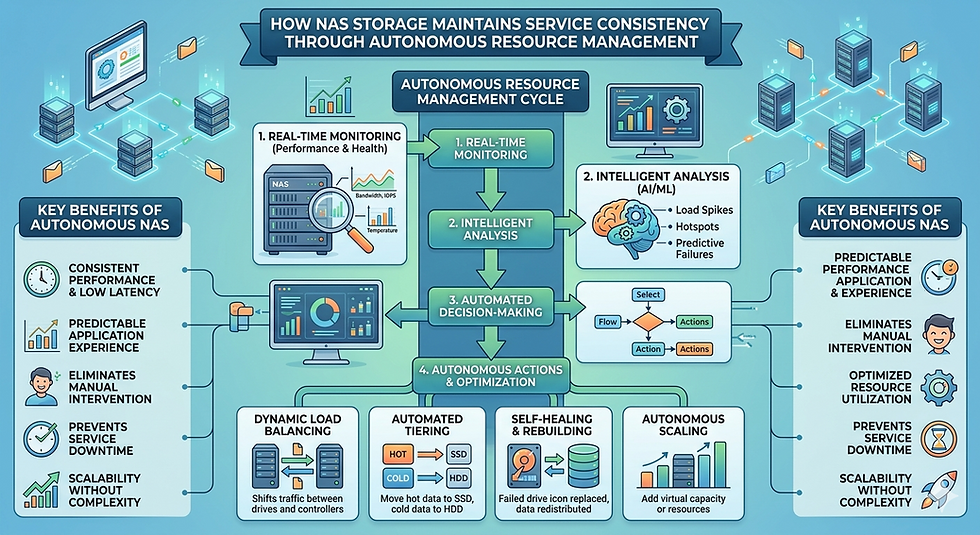
To handle congestion effectively, storage architectures must evolve beyond static assumptions about network behavior. Modern NAS solutions are designed with awareness of network dynamics, allowing them to adapt in real time.
Key architectural shifts include:
1. Network-Aware Data Routing
Instead of sending data through fixed paths, advanced systems dynamically select routes based on current network conditions. This reduces congestion and improves overall efficiency.
2. Distributed Data Access Models
By spreading data across multiple nodes, systems reduce dependency on any single network path. This approach ensures that congestion in one area does not impact the entire system.
3. Adaptive Load Balancing
Workloads are distributed based on both storage and network conditions. This prevents overloading specific nodes or network segments.
Minimizing I/O Bottlenecks Through Intelligent Design
Handling network congestion requires a combination of proactive and reactive strategies. The goal is to ensure that data flow remains smooth even under heavy load.
Dynamic Bandwidth Management
Modern Network Storage Solutions monitor bandwidth usage in real time and adjust data transfer rates accordingly. This prevents sudden spikes from overwhelming the network.
Traffic Prioritization
Not all data is equally critical. By prioritizing important operations, systems ensure that essential workloads are not delayed during congestion.
Parallel Data Streams
Breaking large data transfers into smaller parallel streams allows for more efficient use of available bandwidth, reducing the impact of congestion.
Efficient Queue Management
Intelligent queuing mechanisms prevent request backlogs and ensure that operations are processed in a timely manner.
The Role of Caching in Congestion Mitigation
Caching is a powerful tool for reducing network dependency. By storing frequently accessed data closer to the point of use, systems can minimize the need for repeated data transfers.
In advanced NAS solutions, caching strategies are designed to adapt to changing access patterns.
This includes:
Identifying high-demand data in real time
Adjusting cache allocation dynamically
Reducing redundant network requests
By lowering the volume of network traffic, caching helps alleviate congestion and improve performance.
Handling Bursty Workloads
One of the most challenging aspects of network congestion is dealing with bursty workloads—sudden spikes in data transfer activity. These bursts can overwhelm network resources if not managed properly.
Modern Network Storage Solutions handle bursty traffic by:
Smoothing data transfer rates over time
Temporarily buffering excess data
Distributing load across multiple nodes
These techniques ensure that short-term spikes do not lead to long-term performance degradation.
Enhancing Resilience in Distributed Environments
Resilience is a key requirement for any storage system operating in a networked environment. Systems must be able to maintain performance even when network conditions are less than ideal.
Advanced NAS solutions achieve this by:
Detecting congestion patterns early
Automatically rerouting data flows
Isolating problematic network segments
This ensures that localized issues do not impact the entire storage infrastructure.
Predictive Approaches to Congestion Management
Reactive strategies alone are not enough to handle modern network dynamics. Predictive approaches are becoming increasingly important.
By analyzing historical data and identifying patterns, Network Storage Solutions can anticipate congestion before it occurs. This allows systems to:
Preemptively adjust data routing
Allocate resources more effectively
Avoid potential bottlenecks
Predictive intelligence transforms congestion management from a reactive process into a proactive one.
Balancing Performance and Efficiency
While maximizing performance is important, it must be balanced with efficient resource usage. Overcompensating for congestion by overusing resources can lead to inefficiency and increased costs.
A well-designed system ensures that:
Resources are allocated based on actual demand
Data movement is minimized
Network usage is optimized
This balance is essential for sustainable performance in large-scale environments.
Future Trends in Network Storage Design
The future of storage lies in systems that are fully aware of and responsive to network conditions. Emerging trends include:
AI-driven traffic optimization
Autonomous data routing decisions
Integration with software-defined networking (SDN)
Real-time analytics for network behavior
These innovations will further enhance the ability of NAS solutions to handle complex network dynamics without introducing bottlenecks.
Conclusion
Network congestion is an inevitable challenge in modern distributed storage environments. As workloads become more dynamic and data flows more complex, the risk of I/O bottlenecks increases.
By adopting intelligent design principles, adaptive routing, and predictive strategies, Network Storage Solutions can effectively manage congestion and maintain consistent performance. At the same time, advanced NAS solutions ensure that storage systems remain resilient, scalable, and efficient.
Ultimately, the success of any storage architecture depends on its ability to adapt to changing conditions. In a world where network dynamics are constantly evolving, engineering systems that can handle congestion without compromising performance is no longer optional—it is essential.


Comments