How Modern NAS Solutions Use AI-Based Workload Prediction to Pre-Tier Data and Eliminate Storage Latency Spikes in Enterprise Environments?

Enterprise IT environments demand constant, high-speed data access to support mission-critical applications. As data volumes expand exponentially, legacy storage architectures consistently struggle to keep up with dynamic input/output (I/O) requests. This operational friction results in severe storage latency spikes that disrupt database operations, virtual machine performance, and overall business continuity. To solve this persistent infrastructure challenge, organizations are actively deploying modern NAS solutions equipped with artificial intelligence.
Legacy storage tiering operates on a reactive model. Data is moved to high-performance flash storage only after a system registers a spike in demand. This creates an inevitable delay, forcing applications to wait for data retrieval. By integrating machine learning algorithms, administrators can shift this paradigm from reactive caching to proactive data positioning.
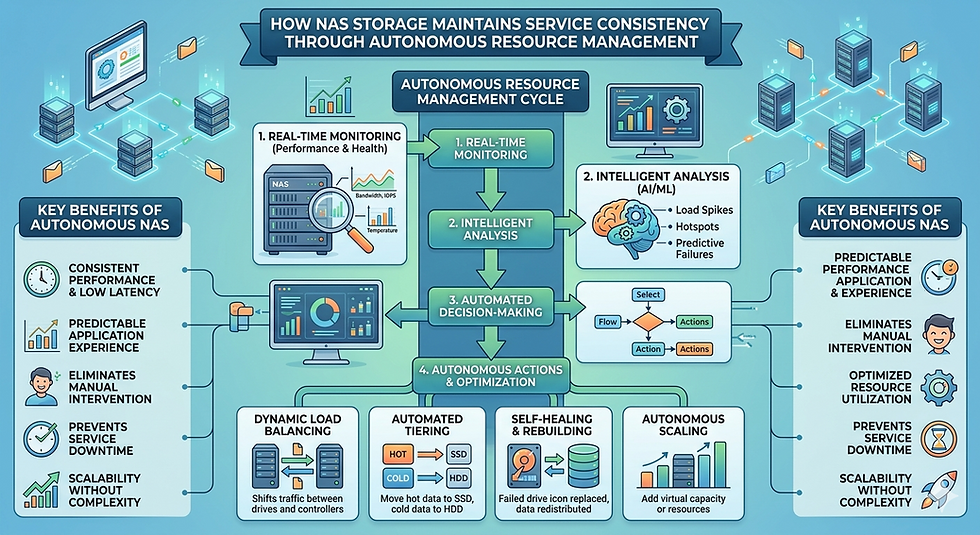
Through the continuous analysis of historical I/O patterns, machine learning algorithms can accurately anticipate future data demands. This allows a modern Nas System to autonomously move data to the optimal storage tier before a performance bottleneck occurs. The result is a seamless, high-performance environment that maintains consistent throughput regardless of load fluctuations.
This article examines the mechanisms behind AI-based workload prediction. It details how intelligent pre-tiering works, the architectural benefits it brings to enterprise storage arrays, and how autonomous management eliminates latency spikes across complex networks.

The Anatomy of Enterprise Storage Latency
Storage latency refers to the time it takes for a storage array to acknowledge and process an I/O request. In enterprise environments, latency spikes frequently occur due to the "I/O blender effect." When hundreds of virtual machines send randomized read and write requests to a centralized storage pool, the storage controller struggles to process the data efficiently.
Traditional auto-tiering mechanisms attempt to mitigate this by promoting hot data to faster drives, such as NVMe or SSDs, and demoting cold data to high-capacity HDDs. Because this process is entirely reactive, the storage controller must first recognize the data as "hot" based on immediate usage frequency. During this recognition and migration period, the application experiences a noticeable delay. For latency-sensitive workloads like real-time financial trading platforms or high-volume transactional databases, even a few milliseconds of delay can result in significant operational degradation.
How AI Enhances Modern NAS Solutions?
Artificial intelligence fundamentally alters how storage controllers manage data placement. Instead of relying on rigid, pre-defined thresholds, AI algorithms continuously ingest telemetry data from the storage network. This includes metadata, access frequencies, time-of-day patterns, and application-specific I/O behaviors.
By applying deep learning models to this telemetry data, modern NAS solutions establish a comprehensive baseline of normal storage operations. The system identifies complex, non-linear correlations between different workloads. For example, the AI might recognize that a specific database backup always triggers a massive read request from a secondary application exactly 15 minutes later.
Armed with this predictive intelligence, the storage controller executes instructions ahead of schedule. It effectively maps out the required data trajectory, ensuring that computational resources are allocated precisely when and where they are needed.
Intelligent Data Pre-Tiering
Data pre-tiering is the direct application of AI workload prediction. When a Nas System utilizes pre-tiering, it physically relocates data blocks from slower, high-capacity storage tiers to ultra-low-latency flash tiers prior to the anticipated application request.
Consider an enterprise running a monthly payroll application. A traditional array will experience a massive latency spike on the first day of the month as the system suddenly pulls terabytes of cold data from spinning disks. An AI-powered Nas System recognizes this recurring monthly pattern. Hours before the payroll application initializes, the storage controller silently promotes the necessary databases to the NVMe tier. When the application finally requests the data, it accesses it at maximum flash speeds, completely avoiding the I/O bottleneck.
Eliminating Latency Spikes in the Enterprise
The primary objective of workload prediction is establishing I/O consistency. By preemptively positioning data, administrators can flatten the latency curve. There are several cascading benefits to this approach.
First, it maximizes the return on investment for high-performance hardware. Flash storage is expensive, and enterprises want to ensure it is utilized efficiently. Predictive algorithms guarantee that the flash tier is populated exclusively with data that actually requires high-speed access at that specific moment, preventing cache pollution.
Second, it drastically reduces the administrative overhead placed on IT teams. Storage administrators no longer need to write complex, manual tiering scripts or constantly monitor dashboards for performance degradation. The automated nature of these systems allows IT personnel to focus on higher-level architectural planning rather than reactive troubleshooting.
Third, AI prediction extends the lifespan of storage media. Unnecessary data movement creates excessive write cycles, which degrades SSD endurance over time. By accurately predicting workload requirements, the system prevents the continuous, unnecessary promotion and demotion of data blocks, preserving the physical integrity of the drives.
Evaluating an AI-Powered Infrastructure
Transitioning to predictive storage requires careful evaluation of existing network architecture. Decision-makers must ensure that their chosen infrastructure supports deep telemetry gathering without introducing controller overhead.
The machine learning models running within these advanced NAS solutions require a brief training period to understand the specific nuances of the host environment. During this initial phase, the system builds its predictive models by observing daily, weekly, and monthly cycles. Once the training phase reaches statistical maturity, the system transitions into an active pre-tiering state, delivering immediate performance enhancements.
Frequently Asked Questions
What differentiates AI workload prediction from traditional caching?
Traditional caching operates reactively, moving data into memory or flash only after an initial request is made. AI workload prediction operates proactively. It analyzes historical patterns to move data to the fastest storage tier before the application ever issues a request, entirely preventing the initial delay.
Will integrating advanced NAS solutions disrupt current operations?
Deploying a modern infrastructure typically involves non-disruptive migration protocols. The AI models operate in the background, analyzing I/O traffic passively. Pre-tiering functions only execute when there is available bandwidth, ensuring that predictive data movement does not interfere with active application workloads.
How quickly does a Nas System learn network patterns?
The learning phase depends on the complexity and regularity of the workloads. Highly repetitive tasks, such as nightly backups, are often mapped within a few days. More complex, month-end financial reporting cycles require a full 30-day period for the algorithm to establish a reliable baseline.
Do all NAS solutions feature this predictive capability?
No. While auto-tiering is a standard feature across most enterprise storage arrays, AI-driven pre-tiering requires dedicated computational resources within the storage controller to run machine learning models. Organizations must specifically seek out vendors that architect their operating systems around proactive AI management.
Can I manually override the AI in a Nas System?
Yes. Enterprise storage operating systems within a NAS System allow administrators to pin specific volumes or datasets to a dedicated tier. This ensures that critical data remains on NVMe storage permanently, regardless of what the predictive algorithms suggest, providing ultimate control to the IT department.
Optimizing Storage Architecture for the Future
As enterprise applications become more distributed and data-intensive, reactive storage management is no longer a viable strategy. Storage latency directly translates to lost productivity and degraded user experiences. By embracing artificial intelligence and machine learning at the infrastructure level, organizations can fundamentally resolve the root cause of I/O bottlenecks.
Transitioning to intelligent pre-tiering ensures that high-performance storage is utilized with mathematical precision. Evaluate your current storage telemetry and begin assessing platforms that offer proactive workload prediction. Upgrading to a predictive architecture is the most definitive step an organization can take toward building a resilient, zero-latency data center.


Comments