Intelligent NAS Solutions for Autonomous Edge Networks: Optimizing Data Flow Without Human Intervention
- Mary J. Williams
- Mar 12
- 4 min read

The volume of data generated at the edge of networks is expanding exponentially. Industrial sensors, remote branch offices, and Internet of Things (IoT) devices constantly capture gigabytes of telemetry, video, and operational data. Managing this influx requires infrastructure capable of processing, storing, and routing information instantly. Relying on manual oversight to direct this traffic is no longer a viable operational strategy.
Intelligent Network Attached Storage (NAS) provides the foundational architecture needed to handle this workload. By embedding machine learning and automated policies directly into the storage layer, organizations can create autonomous edge networks. These networks evaluate data relevance in real-time, deciding what needs immediate processing and what should be archived, completely removing the human bottleneck.
This framework allows enterprises to maintain low latency for critical applications while optimizing bandwidth. Implementing smart NAS solutions transforms a static storage repository into a dynamic data routing engine. Readers will learn the mechanics behind these automated storage architectures, how they interact with cloud ecosystems, and the steps required to implement them within a modern IT infrastructure.

The Architecture of Autonomous Edge Networks
Edge computing shifts data processing closer to the point of origin. This physical proximity reduces the time required for data transmission, ensuring that applications requiring split-second decisions function correctly. However, edge nodes operate in resource-constrained environments. They lack the massive compute and storage capacities found in centralized data centers.
To function autonomously, edge networks require storage systems that actively manage their own capacity and throughput. Traditional storage models expect an administrator to provision volumes, configure replication schedules, and manually clear obsolete files. In an edge environment with hundreds or thousands of distributed nodes, this manual approach causes severe operational delays and increases the risk of system failure due to capacity exhaustion.
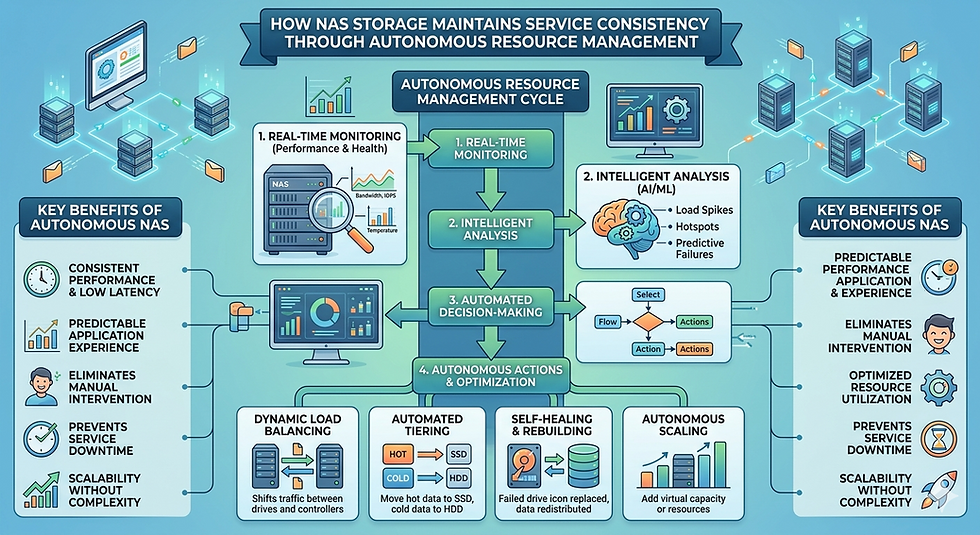
Intelligent NAS solutions resolve this architectural flaw. They utilize predictive algorithms to monitor Input/Output (I/O) patterns and capacity utilization. When a local drive approaches its storage limit, the system automatically compresses older files, deduplicates redundant data, or schedules transfers to a centralized repository.
Mechanisms of Intelligent NAS Storage
Deploying NAS storage at the edge requires specific software capabilities that prioritize autonomy. The hardware itself serves as the physical anchor, but the embedded operating system dictates the efficiency of the data flow.
Predictive Data Tiering
Automated tiering assigns data to different storage media based on its immediate value. Frequently accessed data remains on high-performance solid-state drives (SSDs) at the edge. As data cools, the NAS system automatically migrates it to lower-cost, high-capacity drives. This tiering process requires zero human intervention. The system continuously evaluates access frequencies and adjusts the physical location of the data to maintain optimal read and write speeds for active applications.
Automated Fault Tolerance
Edge environments are inherently volatile. Power fluctuations, physical damage, and network dropouts frequently disrupt operations. Intelligent NAS systems incorporate automated failover mechanisms. If a primary storage node detects a hardware fault, it autonomously reroutes traffic to a secondary node. Concurrently, it alerts the central IT management console, ensuring that operations continue uninterrupted while maintenance teams prepare a replacement.
Integrating Edge Networks with Azure Disk Storage
While edge nodes handle immediate processing, long-term analytics and archival storage require the massive scalability of the cloud. An autonomous edge network must communicate seamlessly with cloud platforms to offload processed data and free up local capacity.
Azure disk storage provides a robust target for these automated migrations. When integrating intelligent NAS solutions with cloud environments, administrators configure policy-driven synchronization. Once these parameters are established, the edge NAS handles the execution.
For example, a remote manufacturing facility might use edge NAS to process quality control video feeds. The local system identifies defective products instantly. At the end of the shift, the NAS solution automatically encrypts the day's footage and transfers it to Azure disk storage for long-term compliance retention. This hybrid approach guarantees that the edge node never runs out of space, while the enterprise retains all historical data in a highly secure, scalable cloud environment.
Key Operational Advantages
Transitioning to an autonomous data management model yields specific operational and financial benefits for enterprise IT departments.
First, it significantly reduces bandwidth consumption. Sending raw, unfiltered data from the edge to a central data center saturates network links and incurs massive egress fees. Intelligent NAS processes and filters this data locally. It only transmits the necessary anomalies or summarized reports to the core network.
Second, it standardizes security protocols across distributed environments. Autonomous NAS solutions enforce encryption at rest and in transit uniformly. If a remote node detects unauthorized access attempts, it can automatically lock down specific volumes or sever its connection to the broader network, isolating the threat without waiting for an administrator's approval.
Executing the Transition to Autonomous Storage
Organizations looking to optimize their edge networks must audit their existing infrastructure. Begin by identifying the specific locations generating the highest volume of unstructured data. Evaluate the current latency metrics and determine where manual storage management is causing bottlenecks.
Next, implement a pilot program utilizing intelligent NAS storage hardware at a single, high-traffic edge location. Configure the automated tiering policies and connect the system to your centralized cloud architecture, such as Azure, to test the automated data offloading processes. Monitor the system's ability to handle peak I/O loads without human intervention. Once the pilot validates the automated workflows, IT teams can standardize the configuration and deploy the architecture across the entire edge network.


Comments