NAS Storage Solutions for Antarctic Autonomous Research Stations Handling Continuous Environmental Data
- Mary J. Williams
- Mar 13
- 5 min read

Antarctic research stations operate at the intersection of scientific ambition and environmental extremity. With temperatures plunging below -80°C, persistent katabatic winds, and near-zero connectivity for months at a time, the infrastructure supporting these stations must be as resilient as the researchers who design them. Among the most critical components of that infrastructure is data storage—specifically, NAS storage solutions capable of handling the relentless output of autonomous environmental monitoring systems.
This post examines what makes NAS storage an effective fit for Antarctic deployments, what technical specifications matter most, and how system architects can design reliable, high-throughput storage environments in one of the world's most demanding settings.

Why Data Storage Is a Core Infrastructure Challenge in Antarctica?
Modern Antarctic research stations are no longer staffed outposts alone. Many operate as fully autonomous or semi-autonomous facilities, running continuous sensor arrays that monitor atmospheric conditions, ice sheet dynamics, seismic activity, ocean temperatures, and more. These systems generate data around the clock—often at high sampling rates—without pause for weather events or communication blackouts.
The data volumes are substantial. A single multi-sensor environmental monitoring array can produce several terabytes of raw data per month. Multiply that across a network of sensors measuring wind speed, CO₂ concentrations, ice thickness, and UV radiation simultaneously, and the storage requirements compound quickly.
Satellite uplink bandwidth in Antarctic deployments is limited and expensive. Transmitting raw data in real time is rarely feasible, which means local storage must buffer everything until a transmission window opens—or until a resupply mission retrieves physical drives. The storage system carries the entire weight of data continuity.
What Makes NAS Storage Solutions Well-Suited to This Environment?
Network-attached storage offers several architectural advantages that align directly with the demands of autonomous Antarctic stations.
Centralized, scalable capacity allows multiple sensor systems and edge computing nodes to write simultaneously to a shared pool of storage over a local network. Rather than managing dozens of isolated drives spread across subsystems, operators can consolidate data onto a single NAS platform with structured directories, unified access protocols, and predictable capacity thresholds.
RAID redundancy is essential when drives cannot be serviced for six months or longer. NAS storage solutions platforms running RAID 6 or RAID-Z2 configurations can tolerate multiple simultaneous drive failures without data loss, giving research teams meaningful protection against mechanical failure in extreme cold.
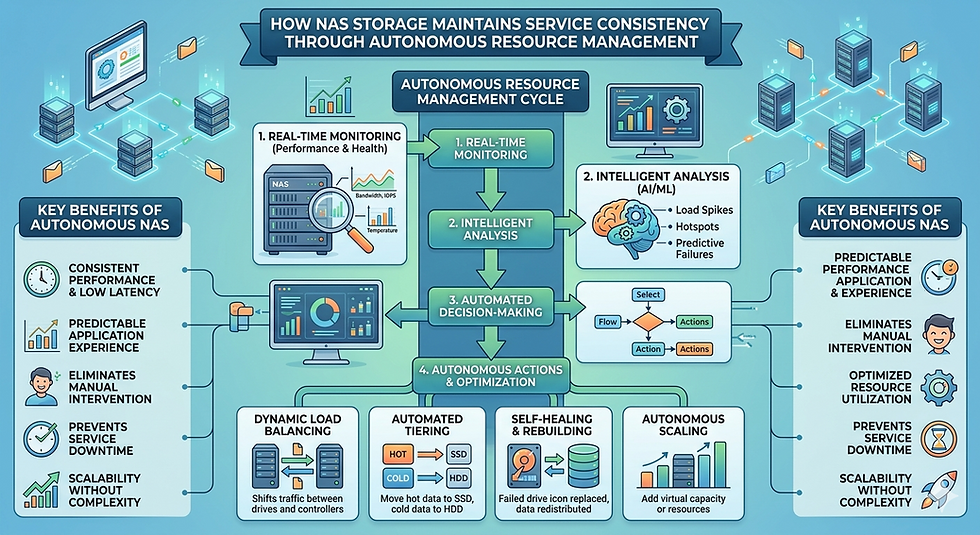
Remote management capabilities are equally important. Most enterprise NAS platforms support out-of-band management interfaces, SNMP monitoring, and automated alerting—allowing technicians in distant operations centers to monitor drive health, storage utilization, and system status without physical access to the station.
Cold-Weather Hardware Considerations for NAS Deployments
Standard NAS enclosures are not designed for sub-zero operating environments. Deploying NAS storage in Antarctica requires either purpose-built cold-weather units or careful thermal management within a heated equipment enclosure.
Drive Selection
Hard disk drives (HDDs) face significant challenges below their rated operating temperatures. Most commercial HDDs are rated for operation down to 0°C—well above the temperatures found in unheated Antarctic structures. Solid-state drives (SSDs) tolerate colder temperatures more reliably, though flash memory can exhibit read/write performance degradation under extreme cold.
For Antarctic NAS deployments, SSD-based or hybrid NAS configurations are generally preferred for primary storage. Where HDDs are used, they should be housed within thermally insulated and actively heated enclosures, with temperature monitoring integrated into the management stack.
Power Stability
Antarctic stations typically draw power from diesel generators or, increasingly, from wind-solar hybrid microgrids. Both sources carry inherent variability. NAS systems should be paired with uninterruptible power supplies (UPS) rated for cold environments and configured with graceful shutdown triggers to protect filesystem integrity during unexpected power events.
Enclosure and Connectivity
Physical enclosures should meet IP54 or higher ingress protection ratings where condensation risk exists. Internal cabling and connectors should be rated for low-temperature flexibility to prevent cracking during handling or thermal cycling. For network connectivity, fiber optic cabling is preferred over copper in longer indoor runs, as it is immune to electromagnetic interference from research instrumentation and maintains consistent performance across temperature ranges.
Data Architecture for Continuous Environmental Monitoring
The structure of the data pipeline matters as much as the hardware itself. Autonomous stations typically run multiple data-generating processes in parallel—sensor polling routines, edge analytics models, image capture systems, and communication buffers. Each of these needs clearly defined write paths to the NAS system.
Tiered Storage Strategy
A tiered approach helps balance performance and capacity. High-frequency sensor data writes to a fast NAS tier (SSD-backed, low-latency), while completed datasets are migrated automatically to a higher-capacity archival tier. This ensures that active write operations are never competing with bulk storage reads during data retrieval tasks.
Many NAS platforms support automated tiering policies natively, which reduces the configuration burden on station operators and ensures consistent data placement without manual intervention.
Data Integrity and Checksumming
Filesystem selection is not a minor decision. ZFS-based NAS platforms provide end-to-end data integrity checking through per-block checksums, which detect and correct silent data corruption—a meaningful risk in environments with magnetic interference or thermal stress on drives. For long-duration deployments where data cannot be verified in real time by human operators, a self-healing filesystem is not optional; it is a baseline requirement.
Backup and Redundancy
Even with RAID protection, NAS storage alone does not constitute a complete backup strategy. A 3-2-1 backup architecture—three copies of data, on two different media types, with one copy offsite—should be adapted to the Antarctic context. In practice, this often means primary NAS storage, a secondary local backup NAS, and periodic synchronization to a satellite-connected cloud storage endpoint during transmission windows.
Operational Monitoring and Remote Administration
Once deployed, an Antarctic NAS system must be manageable without on-site technicians. This places significant requirements on monitoring and alerting infrastructure.
Drive S.M.A.R.T. data should be polled on a scheduled basis, with threshold alerts configured for reallocated sectors, spin-up time anomalies, and temperature excursions. NAS platforms that expose telemetry via SNMP or REST APIs integrate cleanly with centralized monitoring dashboards operated from research headquarters.
Automated storage reports—summarizing write rates, available capacity, error counts, and predicted time-to-full—give remote operators the visibility needed to plan resupply missions or initiate emergency data transfers before capacity is exhausted.
The Right NAS Storage Strategy Pays Off in the Field
Antarctic environmental research depends on data that is complete, uncorrupted, and accessible. Every gap in the storage record represents a gap in the scientific output that the entire operation exists to produce. NAS storage solutions, when specified and deployed correctly, provide the reliability, scalability, and manageability that autonomous polar research demands.
The engineering decisions made before deployment—drive type, RAID configuration, filesystem selection, thermal management, power protection, and monitoring integration—determine whether the system performs for six months without intervention or fails quietly in the cold. There is no margin for ambiguity in these environments.
Research teams and infrastructure architects planning polar deployments should evaluate NAS storage platforms against Antarctic-specific criteria: cold-weather hardware ratings, redundancy tolerance, remote management depth, and filesystem integrity guarantees. A solution adequate for a data center is not automatically adequate for the ice.


Comments