Reducing Cross-Region Data Transfer Latency with Intelligent Network Storage Solutions
- Mary J. Williams
- Feb 11
- 5 min read

For modern businesses, global expansion often brings a hidden bottleneck: data latency. When teams in New York, London, and Singapore need to collaborate on the same massive files, the speed of light—and the limitations of standard internet protocols—suddenly become major obstacles. What should be a simple file save turns into a frustrating waiting game.
Slow data transfer isn't just an annoyance; it’s a productivity killer. It delays project timelines, frustrates employees, and increases the risk of version control errors when users resort to downloading local copies to avoid the lag. As organizations increasingly rely on distributed workforces and cloud infrastructure, the need to move data seamlessly across regions has never been more critical.
Fortunately, the solution doesn't necessarily require rewriting the laws of physics. By leveraging intelligent network storage solutions, businesses can bridge the geographical gap. This article explores the mechanics of cross-region latency, why traditional methods fail, and how modern storage architectures are solving the problem.

The Challenge of Distance: Why Latency Happens
Latency is the delay before a transfer of data begins following an instruction for its transfer. In networking terms, it's the time it takes for a packet of data to travel from point A to point B and for the acknowledgement to return to point A.
While bandwidth (the width of the pipe) has increased exponentially over the last decade, latency (the length of the pipe) remains bound by physical distance, making optimized network storage solutions essential for minimizing delays in data access and transfer.
The Protocol Problem
The issue isn't just distance; it's how our computers talk to each other. Protocols like SMB (Server Message Block) and NFS (Network File System) were designed for local area networks (LANs). They are "chatty" protocols. To open a single file, the client and server might need to exchange hundreds of back-and-forth messages.
On a local network, this happens instantly. But when you introduce 200 milliseconds of latency between a user in Europe and a server in California, those hundreds of round trips add up to agonizing delays. Opening a 50MB PowerPoint presentation might take minutes rather than seconds.
Packet Loss and Jitter
Cross-region transfers also traverse the public internet, which is unpredictable. Data packets often take different routes, arrive out of order, or get dropped entirely. When packets are lost, the transmission protocol (usually TCP) slows down to ensure data integrity, further throttling the speed.
Why Traditional VPNs and WAN Optimization Aren't Enough?
Historically, IT departments tried to solve this with Virtual Private Networks (VPNs) or WAN optimization hardware. While these tools have their place, they often fall short for heavy data workflows.
VPNs secure the tunnel, but they encapsulate data, which adds overhead. They don't inherently fix the "chattiness" of file protocols. WAN optimization appliances can compress data and deduplicate traffic, but they are expensive hardware solutions that require maintenance at every endpoint. In a cloud-first world, racking hardware in every branch office is becoming obsolete.
Enter Intelligent Network Storage Solutions
To truly solve cross-region latency, we need to move the data closer to the user or change how the data is accessed. This is where modern network storage solutions come into play. These systems use intelligent caching and global file systems to make remote data feel local.
1. Global File Systems with Edge Caching
The most effective approach involves a cloud-native global file system. In this architecture, the "master" copy of the data lives in the cloud (object storage). However, edge appliances (virtual or physical) are deployed in each local office or region.
These appliances act as intelligent caches. When a user in London accesses a file, the system checks the local cache. If the file is there, it opens instantly at LAN speed. If it's not, the system fetches only the bits of data requested, not the whole file.
Benefits:
Local Performance: Users experience the speed of a local server.
File Locking: Intelligent systems handle global file locking, preventing version conflicts even if users are thousands of miles apart.
Reduced Bandwidth: Only changed data blocks are transmitted across the network, significantly lowering bandwidth costs.
2. The Evolution of Network Attached Storage (NAS)
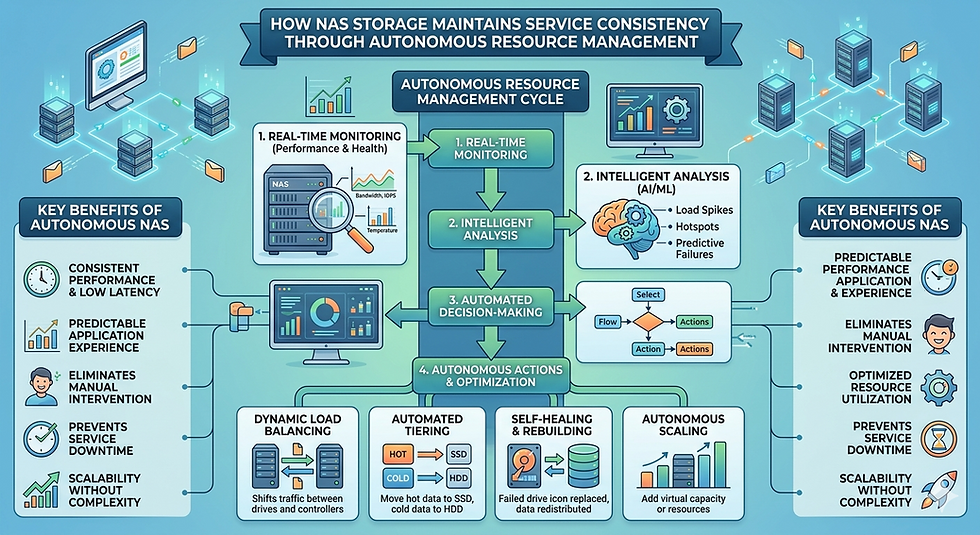
Traditional Network Attached Storage (NAS) was a box in a closet. Today, NAS is evolving into hybrid cloud environments. Modern NAS filers can sync data asynchronously across regions.
For example, a design firm might have a primary NAS in New York and a secondary one in Tokyo. Intelligent software replicates data between them in the background. While this ensures data availability, true real-time collaboration requires the more advanced file locking capabilities found in global file systems mentioned above.
However, for read-heavy workloads—like distributing software updates or reference media—replicating Network Attached Storage across regions ensures that users are always pulling data from a node geographically close to them.
3. Protocol Optimization
Newer software-defined storage solutions are rewriting how data travels. Instead of using standard TCP, which is sensitive to latency, some solutions utilize UDP-based accelerated file transfer protocols. These are designed to maximize bandwidth utilization regardless of distance or packet loss, blasting data through the pipe much faster than traditional methods.
Implementation Strategies for Reducing Latency
Adopting these solutions requires a strategic approach. Here is how organizations can start optimizing their cross-region data flows.
Assess Your Data Gravity
Identify where your data currently lives and where it is consumed. Is it centered in one data center while users are distributed? Or is data scattered across employee laptops? Understanding "data gravity" helps you decide where to place your storage resources.
Adopt a "Cloud-Core, Edge-Active" Model
Centralize your unstructured data in a scalable cloud object store (like AWS S3 or Azure Blob). This becomes your single source of truth. Then, deploy intelligent edge caching software and network attached storage at your branch locations. This allows you to retire aging local file servers while boosting performance.
Prioritize Active Data
Not all data needs to be instantly accessible everywhere. Intelligent network storage solutions often include tiering capabilities. They keep "hot" (frequently accessed) data cached locally on high-speed flash storage, while "cold" (archived) data stays in the cloud, accessible but not taking up expensive local space.
The Future of Global Collaboration
Reducing latency is about more than just speed; it's about enabling a seamless workflow. When a video editor in Los Angeles can collaborate on a project with a colorist in Paris without shipping hard drives, the creative process accelerates. When a financial analyst in Hong Kong can query a database in New York instantly, decisions happen faster.
By moving away from legacy protocols and embracing intelligent network storage solutions, businesses can finally break the speed limit imposed by geography. The world isn't getting any smaller, but with the right technology, your network can make it feel that way.


Comments