Using Network Attached Storage to Manage Multi-Year Environmental and Sensor Data from Field Research Sites
- Mary J. Williams
- Mar 5
- 3 min read

Environmental research requires consistent, long-term data collection to establish accurate models and identify ecological trends. Sensors deployed across remote field sites generate massive, continuous datasets over multiple years. Managing this incoming telemetry securely is a critical operational requirement for modern scientific institutions.
Researchers face the ongoing challenge of maintaining data integrity while ensuring these expanding datasets remain highly accessible for longitudinal analysis. Traditional direct-attached storage architectures frequently fail to meet the operational demands of high-volume, continuous sensor outputs. Hardware degrades, capacity limits are reached unexpectedly, and localized storage creates isolated data silos that hinder collaborative research.
To mitigate data loss and improve accessibility, research institutions must deploy systematic, centralized storage architectures. Implementing robust infrastructure ensures that multi-year environmental data remains secure, verifiable, and readily available for complex computational analysis.

The Challenge of Environmental Data Accumulation
Field research sites utilize an array of sensors to monitor variables such as temperature, humidity, soil chemistry, and atmospheric pressure. These devices often transmit data at high frequencies, creating a compounding storage requirement that must be managed efficiently. Implementing network attached storage allows research teams to centralize sensor data, ensure reliable data ingestion, and maintain organized repositories for long-term environmental analysis.
Continuous Telemetry and Capacity Limits
A single environmental sensor might generate only a few megabytes of data daily. However, a comprehensive field site deploying hundreds of sensors over a five-year study will generate terabytes of vital information. Direct-attached storage devices, such as local hard drives or standard USB drives, lack the necessary fault tolerance and scalability to handle this constant influx of data reliably.
Data Integrity and Remote Accessibility
Scientific validity relies on absolute data integrity. Information collected from the field must be protected against hardware failure, data corruption, and unauthorized access. Furthermore, research teams are often distributed across multiple geographic locations. They require simultaneous, secure access to the same datasets to perform concurrent analysis without creating conflicting file versions.
Implementing Network Attached Storage
Network Attached storage provides a dedicated, centralized repository that allows multiple users and client devices to retrieve data from a centralized disk capacity. Unlike standard external drives, this architecture connects directly to the network, functioning as an independent node dedicated solely to file sharing and data protection.
Deploying Network Attached storage for field research offers immediate structural benefits. Incoming sensor data can be routed automatically to a centralized directory. This eliminates the need for manual data transfers from field laptops, significantly reducing the probability of human error or accidental data deletion. Built-in redundancy protocols, such as RAID (Redundant Array of Independent Disks), ensure that if a single drive fails, the environmental data remains intact and accessible.
Advantages of Scale Out NAS Storage
As a multi-year environmental study progresses, storage requirements will inevitably exceed initial projections. Traditional storage systems require "scaling up," which involves replacing existing hardware with larger, more expensive servers. This process requires system downtime and disrupts ongoing data collection.
Scale out nas Storage offers a precise, systematic alternative. Instead of replacing the existing central server, network administrators can simply add new storage nodes to the existing cluster.
Seamless Capacity Expansion
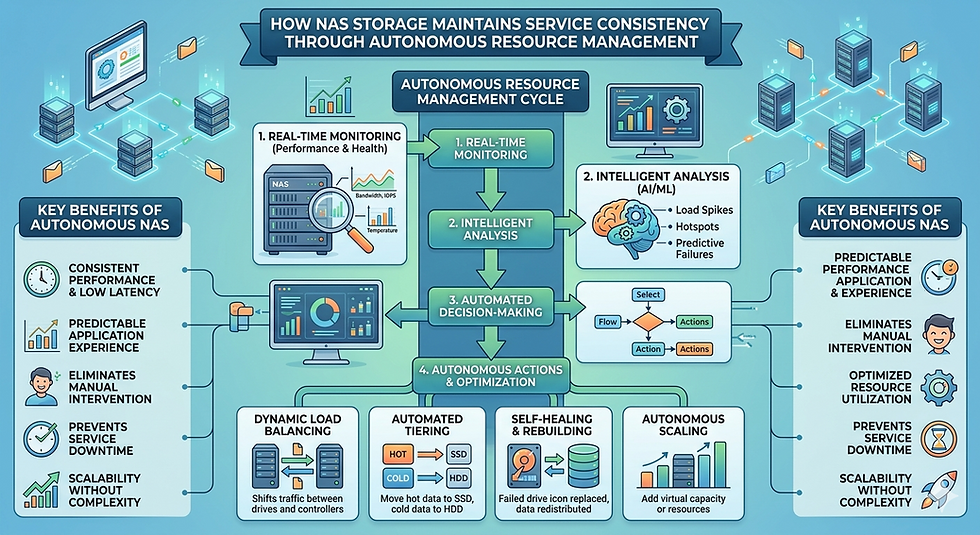
Scale out nas Storage integrates new hardware seamlessly into the existing file system. The infrastructure automatically balances the data load across the new and existing nodes. This architecture allows research institutions to expand their storage capacity incrementally, aligning hardware expenditures with the actual data growth of the environmental study.
Sustained Performance During Data Retrieval
In multi-year studies, researchers frequently need to run complex queries against massive historical datasets. Scale out nas Storage increases both capacity and performance simultaneously. Because each new node adds its own processing power and bandwidth to the cluster, the system maintains high data transfer speeds even as the total volume of stored sensor data grows into the petabyte range.
Best Practices for Research Deployment
To maximize the reliability of your storage architecture, specific deployment protocols must be established from the outset of the research project.
Automated Replication and Backups
Configure your Network Attached storage to perform automated, asynchronous replication to a secondary location. This could be an off-site server or a secure cloud repository. Establishing a strict 3-2-1 backup protocol guarantees that catastrophic hardware failures or localized network outages will not result in the permanent loss of multi-year sensor data.
Standardized Directory Structures
Implement a logical, uniform directory structure before the first sensor transmits data. Categorize files strictly by site location, sensor type, and timestamp. Utilizing automated scripts to format and route incoming telemetry ensures that the data repository remains organized and searchable as it scales over the years.
Optimizing Your Data Infrastructure
Securing multi-year environmental data requires a deliberate shift from localized hardware to robust, networked architectures. By adopting scalable storage solutions, research institutions can protect their data assets, streamline collaborative analysis, and ensure the long-term viability of their scientific endeavors. Evaluate your current data management protocols today, and consider implementing scale-out architectures to future-proof your upcoming field research deployments.


Comments