What Is Network Attached Storage and How Does It Optimize Data Retrieval in Deeply Nested File Structures?

Organizations generate vast amounts of unstructured data every single day. This information rarely exists in a flat, easily accessible format. Instead, system administrators and automated applications organize files into complex hierarchies. These deeply nested directories can contain millions of files spread across thousands of subfolders.
Navigating these dense architectural trees requires significant computational overhead. Standard storage solutions often struggle to process the metadata necessary to locate a specific file buried ten levels deep. This latency bottlenecks application performance and limits overall enterprise productivity.
Resolving these bottlenecks requires specialized storage architectures designed specifically for file-level operations. This article explains what is network attached storage and examines the specific technical mechanisms it uses to accelerate data retrieval across highly complex file trees. Readers will learn how modern storage configurations handle metadata, manage caching, and scale resources to maintain high-speed access to critical data.

Understanding What Is Network Attached Storage
At its core, what is network attached storage? Network attached storage (NAS) is a dedicated file-level storage architecture connected directly to a network. It provides centralized data access to heterogeneous clients and user groups. Unlike direct-attached storage (DAS), which requires a direct physical connection to a single computer, a NAS device operates as an independent network node. It possesses its own IP address and utilizes standard Ethernet connections.
NAS devices run specialized operating systems optimized entirely for file serving and data storage. They utilize standard network protocols such as Network File System (NFS) for UNIX/Linux environments and Server Message Block (SMB/CIFS) for Windows environments. By abstracting the storage hardware from the application servers, NAS allows multiple client machines to access the same centralized file system simultaneously.
This centralization is the foundational element for managing complex data. Because the NAS operating system handles all file I/O operations, it can apply advanced algorithms to organize and retrieve data far more efficiently than a standard general-purpose operating system.
The Challenge of Deeply Nested File Structures
To understand how NAS improves retrieval, we must first examine why nested directories cause performance degradation. Every file and folder in a file system has associated metadata. This metadata includes permissions, creation dates, file sizes, and the physical location of the data blocks on the storage media.
In a UNIX-based system, this metadata is stored in an inode. When a user requests a file located within a deeply nested directory (for example, /project/2023/q4/marketing/campaigns/video/assets/final/clip.mp4), the system cannot simply jump to the final file. The file system must read the directory file for /project, find the inode for 2023, read that directory file, find the inode for q4, and so on.
This process requires a sequential series of metadata lookups. In a standard storage setup, each lookup might require a separate physical read operation from the hard drives. If the directory tree is highly populated, the storage controller experiences a massive spike in random I/O operations. The result is high latency, where the system spends more time traversing the directory tree than actually reading the requested file data.
Technical Mechanisms for Accelerated Data Retrieval
NAS systems deploy several advanced features to mitigate the latency associated with metadata traversal. By isolating file management on dedicated hardware, these systems execute operations at the kernel level of their specialized operating systems.
Aggressive Metadata Caching
The most effective way to eliminate the latency of sequential directory lookups is to avoid reading from the physical disks entirely. Modern NAS systems dedicate a large portion of their high-speed Random Access Memory (RAM) to caching metadata.
When a user or application accesses a directory path for the first time, the NAS stores the associated inodes and directory structures in the RAM cache. Subsequent requests for files within that same directory tree are resolved instantly from memory. High-end NAS appliances often utilize Non-Volatile Memory Express (NVMe) solid-state drives as a secondary cache tier. This tiered approach ensures that even vast directory trees remain indexed in high-speed storage, drastically reducing the time required to resolve a file path.
Parallel Processing and Multithreading
General-purpose operating systems often process file requests serially. NAS operating systems are engineered to handle thousands of concurrent connections. When multiple clients request files buried deep within different branches of a directory tree, the NAS processor allocates independent threads to handle each path resolution.
This parallel processing capability prevents metadata lookups from queuing up and causing a bottleneck. The NAS controller can calculate physical block locations for multiple deeply nested files simultaneously, instructing the underlying storage array to retrieve the data in the most efficient physical order.
Intelligent File System Design
Traditional file systems like FAT32 or older versions of NTFS suffer from severe fragmentation and performance drops as directory density increases. NAS devices utilize advanced file systems such as ZFS, Btrfs, or proprietary enterprise file systems.
These modern file systems use B-trees or similar dynamic data structures to manage directory contents. Instead of searching a directory sequentially to find a specific subfolder, a B-tree allows the file system to locate the correct metadata entry with logarithmic efficiency. This means the time it takes to find a folder remains incredibly low, even if the parent directory contains millions of individual items.
The Role of Scale Out NAS Storage
As enterprise data grows, a single NAS appliance may eventually reach its processor or memory limits. When the metadata cache becomes too small to hold the active directory trees, performance drops. To solve this, organizations deploy Scale out nas Storage.
Standard NAS architectures scale vertically (scale-up), meaning administrators must add more RAM or storage drives to a single controller. Scale out nas Storage operates differently. It allows administrators to add entirely new NAS nodes to the network. These nodes cluster together to create a single, massive storage pool with a unified namespace.
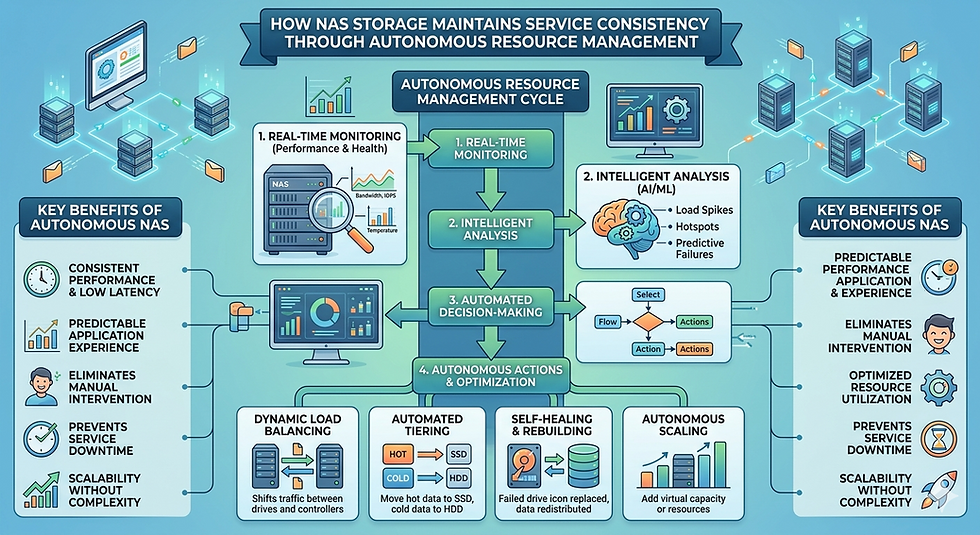
In a deeply nested file structure, Scale out nas Storage distributes the computational load of directory traversal across multiple controllers. If a specific branch of the directory tree becomes highly active, the cluster can dynamically allocate CPU and RAM resources from multiple nodes to handle the metadata lookups. This distributed architecture ensures that data retrieval speeds remain consistently high, regardless of how complex the folder hierarchy becomes or how much total data the organization accumulates.
Optimizing Your Enterprise Architecture
Managing unstructured data requires storage architecture capable of handling intense computational workloads. Standard servers and direct-attached arrays quickly succumb to the metadata overhead generated by highly populated, deeply nested directory trees.
Implementing network attached storage provides the dedicated processing power, aggressive caching, and advanced file systems necessary to resolve complex file paths instantly. For organizations anticipating significant data growth, transitioning to a scale-out architecture guarantees that storage performance will scale linearly alongside capacity. System administrators should audit their current directory structures and I/O latency metrics to determine if a specialized file-level storage solution is required to maintain operational efficiency.


Comments