Enterprise NAS for Multi-Cloud Exit Strategies: How On-Prem Storage Reduces Vendor Lock-In Without Sacrificing Performance?
- Mary J. Williams
- Feb 26
- 5 min read

Cloud migration promised flexibility, scalability, and cost savings. But for many enterprises, the reality has been different. Hidden egress fees, spiraling storage costs, and rigid vendor ecosystems have turned what seemed like a solution into a trap.
If your organization is feeling the squeeze of vendor lock-in, you're not alone. More businesses are reconsidering their all-in cloud strategies and exploring hybrid approaches that combine cloud convenience with on-premises control. At the heart of these multi-cloud exit strategies is enterprise NAS—a proven storage solution that delivers performance, flexibility, and true data ownership.
This post explores how enterprise NAS and scale out storage can help you reduce dependence on cloud vendors without compromising the speed and reliability your business demands.

Understanding the Vendor Lock-In Problem
Vendor lock-in occurs when switching providers becomes prohibitively expensive or complex. Cloud platforms make it easy to upload data, but getting it back out? That's when the fees start piling up.
Egress charges—the costs associated with transferring data out of a cloud provider—can be astronomical. For organizations managing petabytes of information, these fees quickly erode any savings gained from cloud adoption. Add proprietary APIs, platform-specific tools, and integration dependencies, and you've got a recipe for long-term commitment whether you like it or not.
Beyond cost, there's the issue of control. When your data lives entirely in someone else's infrastructure, you're subject to their uptime, their security protocols, and their pricing changes. For regulated industries or businesses with strict compliance requirements, this lack of autonomy is unacceptable. Implementing Enterprise NAS solutions gives organizations full control over their data, ensuring predictable performance, security, and compliance without relying entirely on third-party providers.
How Enterprise NAS Supports Multi-Cloud Exit Strategies?
Enterprise NAS offers a middle ground. By bringing critical workloads and data back on-premises, you regain control while maintaining the option to use cloud resources strategically.
Control Over Your Data
With a NAS system, your data lives in your data center. You decide who has access, how it's protected, and when—or if—it moves to the cloud. This level of ownership is especially valuable for sensitive information or workloads with strict regulatory requirements.
On-premises storage also eliminates egress fees. Moving data between local servers and storage arrays costs nothing, giving you the freedom to restructure, analyze, or archive without worrying about surprise charges.
Cost Predictability
Cloud billing can be opaque. Storage costs, compute charges, API calls, and data transfer fees add up in ways that are difficult to forecast. Enterprise NAS provides predictable capital expenses. You pay upfront for hardware and capacity, then manage it over its lifespan without monthly surprises.
For organizations with stable or growing storage needs, this model often proves more economical over time. Instead of renting storage indefinitely, you own the infrastructure and amortize the cost.
Performance Without Compromise
One concern about moving away from the cloud is performance. Will on-premises storage be fast enough?
Modern enterprise NAS systems are built for speed. With solid-state drives (SSDs), high-speed networking, and optimized file systems, these platforms can match or exceed cloud performance for many workloads. For latency-sensitive applications like video editing, database management, or real-time analytics, local storage often performs better than cloud alternatives simply because the data is closer to the compute resources that need it.
Scale out storage takes this further. Instead of relying on a single monolithic storage array, scale out architectures distribute data across multiple nodes. As your needs grow, you add more nodes to increase both capacity and performance. This approach delivers the scalability of the cloud with the control and speed of on-premises infrastructure.
Designing a Hybrid Strategy with Enterprise NAS
Exiting the cloud doesn't mean abandoning it entirely. The most effective strategies use enterprise NAS as the foundation for a hybrid model that leverages cloud services where they make sense.
Tier Your Data
Not all data needs the same level of accessibility or performance. Hot data—files and workloads accessed frequently—belongs on fast, local storage. Warm data can live on less expensive NAS tiers. Cold data, like archives or backups, can be stored in low-cost cloud object storage.
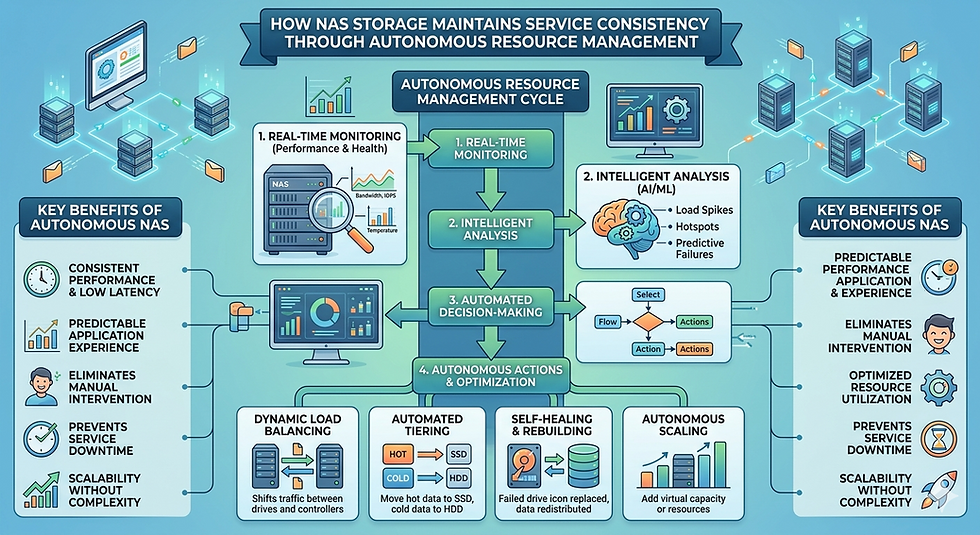
Enterprise NAS makes this tiering seamless. Many systems support automated data lifecycle policies that move files between tiers based on usage patterns. You get the performance you need for active workloads and the cost efficiency of cloud storage for everything else.
Use Cloud for Burst Capacity
Even with robust on-premises infrastructure, there are times when demand spikes unexpectedly. A NAS system can integrate with cloud resources to handle these bursts without over-provisioning local hardware.
For example, if your team needs to process a large batch of data for a one-time project, you can spin up cloud compute instances, pull the necessary data from your NAS, and shut everything down when the job is done. You've used the cloud strategically without committing long-term.
Maintain Redundancy Across Locations
Hybrid strategies also enhance disaster recovery. By replicating data from your enterprise NAS to a secondary site or cloud storage, you create resilient backups without putting all your eggs in one basket. If your primary data center goes offline, you can failover to the cloud. When it's back up, you replicate data back to your NAS.
This approach gives you the best of both worlds: the control and performance of on-premises storage with the geographic redundancy and flexibility of the cloud.
Choosing the Right Enterprise NAS for Your Exit Strategy
Not all NAS systems are created equal. When evaluating options for a multi-cloud exit strategy, prioritize these features:
Scalability: Look for scale out storage architectures that let you expand capacity and performance incrementally. This ensures your infrastructure grows with your business without requiring expensive forklift upgrades.
Interoperability: Your NAS should integrate smoothly with existing cloud services, backup tools, and applications. Open standards and broad protocol support (NFS, SMB, iSCSI, S3-compatible APIs) are essential.
Performance: Ensure the system can handle your workloads. Evaluate IOPS, throughput, and latency, especially for performance-sensitive applications.
Data Management: Advanced features like snapshots, deduplication, compression, and automated tiering can reduce costs and simplify operations.
Security and Compliance: On-premises storage must meet the same—or higher—security standards as cloud alternatives. Look for encryption at rest and in transit, role-based access controls, and audit logging.
Moving Forward: Reclaiming Control
Vendor lock-in isn't inevitable. With the right infrastructure, you can build a storage strategy that prioritizes flexibility, performance, and cost control.
Enterprise NAS offers a proven path forward. By anchoring your data on-premises and using the cloud selectively, you reduce dependence on any single vendor while maintaining the agility your business needs. Scale out storage ensures you're never boxed in by capacity constraints, and hybrid workflows let you use cloud resources strategically rather than by default.
If your organization is ready to rethink its relationship with the cloud, start by evaluating where enterprise NAS can fit into your architecture. The result won't just be lower costs—it'll be greater control over one of your most valuable assets: your data.


Comments