How NAS Storage Enables AI-Driven Genomics and Life Sciences Research?
- Mary J. Williams
- Feb 5
- 5 min read

The intersection of artificial intelligence and life sciences has ushered in a new era of medical breakthrough. We are no longer just observing biological processes; we are predicting them, modeling them, and interacting with them in ways that were impossible a decade ago. At the heart of this revolution lies a massive, often overlooked challenge: data management.
Genomic sequencing and molecular modeling generate staggering amounts of unstructured data. A single human genome sequence can consume huge amounts of digital space, and when you multiply that by population-scale studies, you enter the realm of petabytes. Artificial Intelligence (AI) and Machine Learning (ML) are the only tools capable of analyzing this volume of information to find patterns and anomalies. However, these powerful algorithms are only as fast as the infrastructure supporting them.
If the storage system cannot feed data to the AI models quickly enough, research stalls. This is where Network Attached Storage (NAS), and specifically scale-out NAS, becomes the unsung hero of modern biotech. By providing the necessary speed, scalability, and accessibility, high-performance storage solutions are turning data bottlenecks into pipelines of discovery.

The Data Deluge in Modern Biology
To understand the storage requirements of modern labs, we must look at the nature of the data. Life sciences data is overwhelmingly unstructured. It comes in the form of high-resolution microscopic images, raw genomic sequences, cryo-EM data, and complex chemical models. Unlike structured data (like a database of patient names and addresses), unstructured data is heavy and difficult to manage. It requires a file-based NAS storage system that can organize millions of distinct files in a way that makes them instantly retrievable.
Furthermore, the volume is expanding exponentially. As the cost of Next-Generation Sequencing (NGS) drops, labs are sequencing more frequently and with higher fidelity. This creates a "deluge" where the speed of data creation often outpaces the speed at which IT infrastructure can be upgraded. Traditional legacy storage systems, designed for general corporate file sharing, simply crumble under the I/O (Input/Output) pressure of a modern genomic pipeline.
Why AI Needs High-Performance Storage?
Artificial intelligence models are voracious consumers of data. In a typical workflow, a machine learning algorithm might need to read millions of genomic fragments to "learn" how to identify a specific genetic marker associated with a disease. This process is called training.
During training, expensive GPU-powered compute nodes request data from the storage system. If the storage system has high latency (delay), the GPUs sit idle, waiting for information. This is known as "starving the GPU." It results in wasted investment and, more importantly, lost time.
For AI to function effectively in life sciences, the underlying storage must offer:
Low Latency: Immediate response times for data requests.
High Throughput: The ability to move massive amounts of data through the "pipe" at once.
Parallel Access: The ability for multiple compute nodes to read the same datasets simultaneously without slowing down.
The Role of NAS Storage in Research
Network Attached Storage (NAS) has established itself as the standard for life sciences because of its inherent ability to handle file-based data. Unlike Storage Area Networks (SAN), which are block-based and complex to manage for file sharing, NAS is designed to be accessible over a network by multiple users and applications.
In a research environment, collaboration is key. A sequencer might write data to the storage, a cleaning algorithm might process it, and a team of scientists might visualize it—all accessing the same NAS storage system. This centralization eliminates the need to copy data back and forth between local hard drives, which ensures data integrity and saves time.
However, not all NAS is created equal. A standard NAS unit might suffice for a small lab, but when you introduce AI workloads and petabytes of data, you need a more robust architecture.
The Critical Importance of Scale-out NAS
The specific architecture required for AI-driven genomics is scale-out NAS.
Traditional "scale-up" storage has a fixed limit. You buy a controller (the brain) and fill it with hard drives. When the drives are full, you can add an expansion shelf, but you are still limited by the performance of that single original controller. Eventually, you hit a wall where adding more space degrades performance.
Scale-out NAS works differently. It creates a clustered system where you add "nodes." Each node contains its own storage capacity and its own processing power (CPU and RAM).
Linear Scalability
When you add a node to a scale-out NAS cluster, you aren't just adding terabytes of space; you are also adding the performance bandwidth to handle that space. This allows performance to scale linearly. As your genomic dataset grows from 1PB to 10PB, your system’s ability to serve that data grows with it.
Eliminating Silos
Scale-out architectures present all the storage nodes as a single, massive namespace. A researcher doesn't need to know which specific drive their file is on. They just see one drive letter or mount point. This eliminates "data silos"—isolated pockets of data that are hard to share or analyze collectively. For AI, which often needs to see the entire dataset to form accurate conclusions, a single namespace is non-negotiable.
Managing the Lifecycle of Genomic Data
Cost is a major factor in research. Storing petabytes of data entirely on high-performance All-Flash storage is often prohibitively expensive. However, keeping it on slow, spinning hard drives makes AI analysis impossible.
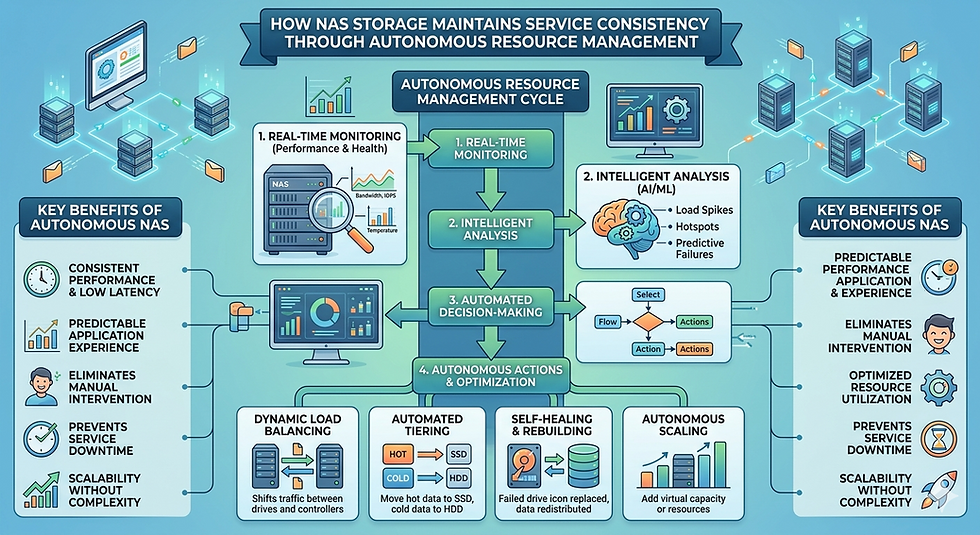
Modern NAS storage solutions solve this through intelligent tiering. The system automatically identifies "hot" data—files currently being analyzed or sequenced—and keeps them on the fastest flash media. Once the analysis is complete and the paper is published, that data becomes "cold." The system automatically moves it to a lower-cost tier (like high-capacity spinning disk or cloud object storage) without breaking the file path.
If a researcher needs to access that old file three years later, the system retrieves it seamlessly. This lifecycle management ensures that labs maximize their budget, spending money on speed only where it counts.
Security and Compliance
Life sciences research often involves sensitive patient data, making it subject to strict regulations like HIPAA or GDPR. The storage infrastructure must be secure. Enterprise-grade scale-out NAS provides essential security features such as:
Encryption at rest and in flight: Ensuring data is unreadable if intercepted or if a drive is stolen.
Immutable Snapshots: Protecting against ransomware. If a virus encrypts the active file system, the lab can instantly roll back to a clean, locked copy of the data from an hour ago.
Audit Trails: Tracking exactly who accessed what file and when, which is critical for compliance audits.
By leveraging scale-out NAS, life sciences labs can scale their storage seamlessly while maintaining these robust security and compliance controls.
The Future of the Lab
The pace of discovery is accelerating. We are moving toward an era of personalized medicine, where a patient's specific genetic makeup will determine their treatment plan in real-time. This requires a digital infrastructure that is invisible to the user—it just works, instantly and reliably.
By deploying robust NAS storage and leveraging the infinite expandability of scale-out NAS, research institutions provide the necessary foundation for AI. When the storage bottleneck is removed, scientists stop waiting on progress bars and start focusing on the science. In the race to cure diseases and understand the building blocks of life, the right IT infrastructure isn't just a support system; it is a catalyst for innovation.


Comments