How Scale Out NAS Coordinates Distributed Resource Awareness Across Growing Clusters?

As enterprise data volumes expand at unprecedented rates, IT administrators face the complex challenge of maintaining storage performance, capacity, and reliability. Traditional storage architectures often struggle to keep pace, leading to bottlenecks and expensive forklift upgrades. This operational reality demands a more resilient approach to data management.
A scale out NAS architecture provides a robust solution to these capacity and performance challenges. By allowing organizations to add independent storage nodes to an existing cluster, this architecture expands seamlessly. However, the true technical achievement of a scale out NAS lies not just in adding hardware, but in how the software coordinates these disparate nodes into a single, cohesive storage pool.
Understanding how distributed resource awareness functions across growing clusters is critical for storage architects and system administrators. This article details the underlying mechanisms that allow a scale out NAS to monitor compute, network, and disk resources across a decentralized infrastructure. By exploring metadata management, consensus algorithms, and load balancing, you will gain a comprehensive view of how modern storage clusters maintain high availability and performance at scale.

The Architectural Foundation of Scale Out Storage
At the core of any scale-out storage environment is the principle of distributed architecture. Unlike traditional monolithic storage, which relies on dual controllers managing a fixed pool of disk enclosures, a distributed approach uses a cluster of independent nodes. Each node contains its own CPU, memory, network interfaces, and storage media.
When you deploy a scale out NAS, these individual nodes communicate over a high-speed backend network. The software layer abstracts the physical hardware, presenting a unified global namespace to clients and applications. This means users access files from a single directory structure, completely unaware that the underlying data might be distributed across dozens or even hundreds of physical servers.
To maintain this illusion of a single machine, the system must maintain continuous distributed resource awareness. Every node must know the state, capacity, and operational health of every other node in the cluster. This continuous state synchronization is what allows scale out storage to route client requests efficiently and rebuild data automatically in the event of hardware failure.
Mechanisms of Distributed Resource Awareness
Coordinating multiple independent hardware nodes requires sophisticated software mechanisms. A modern NAS system relies on several foundational technologies to track resources and ensure data consistency across the cluster.
Global Metadata Management
Metadata serves as the map of the storage environment, detailing where specific file blocks reside on physical disks. In a growing scale out NAS, managing metadata efficiently is paramount. Rather than relying on a centralized metadata server, which could become a performance bottleneck or a single point of failure, enterprise architectures distribute this metadata across the cluster.
Nodes use distributed hash tables or similar decentralized data structures to track file locations. When a client requests a file, the NAS system quickly calculates which node holds the relevant metadata, retrieves the physical location of the data blocks, and serves the file. This distributed approach ensures that as you add more nodes to the scale out storage environment, both capacity and metadata processing power increase simultaneously.
Quorum and Consensus Algorithms
Maintaining state consistency across a network of separate machines is a classic problem in distributed computing. A scale out NAS solves this by utilizing consensus algorithms like Paxos or Raft. These protocols allow the nodes to agree on the current state of the cluster, even if individual network packets are delayed or dropped.
Through continuous heartbeat monitoring, nodes verify the health of their peers. If a node stops responding, the remaining nodes use the consensus algorithm to update the cluster state. The NAS system then automatically redirects client traffic away from the failed hardware and initiates data rebuild processes using parity or mirrored blocks stored elsewhere in the cluster.
Dynamic Load Balancing
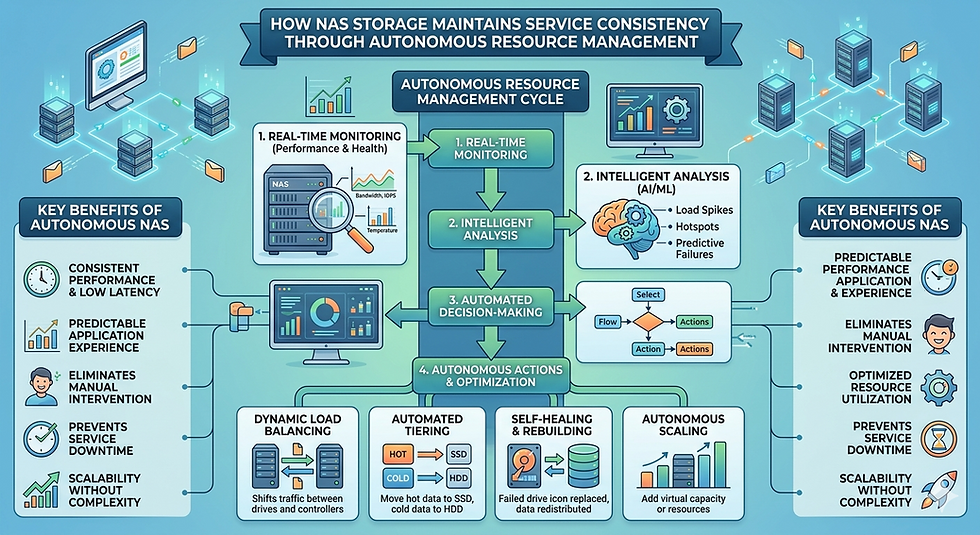
Resource awareness directly translates into performance optimization. Because the system tracks CPU utilization, network throughput, and disk I/O for every node, it can make intelligent decisions about data placement and client connections.
If one node experiences a massive spike in read requests, the scale out NAS can transparently migrate data chunks to less congested nodes or redirect incoming client connections to maintain optimal performance. This dynamic load balancing ensures that no single piece of hardware limits the overall throughput of the scale out storage cluster.
Expanding the NAS System Without Disruption
The primary operational advantage of this architecture is non-disruptive expansion. When an organization approaches its capacity limits, administrators simply rack and cable a new node into the existing network.
Once powered on, the new node announces its presence to the cluster. The existing nodes authenticate the new hardware and update the cluster state using the consensus protocols. The NAS system then automatically begins rebalancing data in the background, moving existing files onto the new node to equalize capacity utilization and improve aggregate performance. This entire process occurs without application downtime or client disruption.
Frequently Asked Questions
How does scale out NAS differ from scale up architecture?
Scale up architecture (traditional NAS) expands capacity by adding disk shelves to an existing pair of storage controllers. Eventually, the controllers reach their maximum processing threshold, requiring a complete system replacement. Scale out NAS expands by adding nodes that contain both storage capacity and processing power, eliminating the controller bottleneck.
What happens to data during a node failure?
When a node fails, the distributed resource awareness protocols immediately detect the loss of heartbeat. The NAS system instantly recalculates the cluster state and reroutes traffic. Data remains accessible because the scale-out storage architecture uses erasure coding or replication to ensure redundant copies of all data exist across the surviving nodes.
Can different hardware models be mixed in a cluster?
Most enterprise scale out storage platforms support heterogeneous clusters. The software layer abstracts the hardware differences, allowing administrators to introduce newer, faster nodes into an existing cluster while gradually retiring older hardware, eliminating complex data migration projects.
Optimizing Your Storage Infrastructure
Scaling data infrastructure requires more than just adding hard drives; it requires intelligent software capable of coordinating independent components into a unified powerhouse. By leveraging distributed metadata, consensus algorithms, and dynamic load balancing, scale out architectures provide a resilient, high-performance foundation for enterprise data.
As your organization evaluates its data management strategy, prioritize architectures that offer robust distributed resource awareness. Implementing a true scale out storage model will ensure your infrastructure remains agile, highly available, and prepared for future capacity demands.


Comments