The Evolution of Network Attached Storage from Passive Storage to Active Infrastructure
- Mary J. Williams
- Dec 23, 2025
- 5 min read

Data used to be something you stored and forgot. In the early days of enterprise computing, storage was simply a destination—a digital warehouse where files went to sit until someone needed to retrieve them. It was static, predictable, and frankly, a bit boring.
However, that narrative has shifted dramatically. Data is no longer just a record of what happened; it is the fuel for what will happen next. As businesses pivot toward real-time analytics, artificial intelligence, and remote collaboration, the underlying hardware must adapt. This shift has forced the evolution of Network Attached Storage (NAS) from a passive repository into a dynamic, active infrastructure layer that powers modern business operations.

The Era of the Digital Filing Cabinet
To understand where we are, we have to look at where we started. Traditional network attached storage systems were designed with a singular, simple purpose: file sharing. You connected a device to your network, and it allowed multiple users to access the same files.
In this "passive" era, the primary metrics for success were capacity and basic reliability. If the drive had enough space and didn't crash, it was doing its job. These systems were excellent for storing spreadsheets, Word documents, and the occasional image library. They were the digital equivalent of a filing cabinet—essential, but functionally isolated from the actual computing power of the organization.
The architecture was typically "scale-up." If you ran out of space, you had to buy a bigger controller or add more shelves of disks behind the same controller. Eventually, you hit a performance wall. The controller became a bottleneck, unable to handle the traffic regardless of how much storage capacity you added. This model worked fine when data was text-based and lightweight, but the digital landscape was about to get much heavier, making modern network attached storage solutions essential.
The Data Explosion and the Need for Speed
Several factors conspired to break the traditional NAS model. First, the sheer volume of data exploded. We aren't just talking about more emails; we are talking about unstructured data. High-definition video, medical imaging, IoT sensor logs, and massive datasets for machine learning became the norm.
Second, the value of data changed. Organizations stopped viewing data as a liability to be archived and started seeing it as an asset to be mined. They needed to access this data instantly, process it, and analyze it.
The passive "filing cabinet" could not keep up. A single controller could not manage the throughput required to stream 4K video to fifty editors simultaneously or feed data to a high-performance compute cluster. The latency was too high, and the scalability was too rigid.
The Rise of Scale-Out NAS
The industry’s answer to these limitations was Scale out NAS.
Unlike the traditional scale-up model, where you simply add more hard drives to a struggling system, scale-out architecture allows you to add "nodes." Each node contains its own storage, but also its own processing power and memory.
When you add a node to a scale-out cluster, you aren't just adding terabytes of space; you are adding the performance bandwidth to manage that space. The system grows linearly. If you double the storage, you double the performance.
This evolution turned NAS into a high-performance beast capable of handling massive concurrency. It allowed media companies to render graphics faster and genomic research centers to process DNA sequences in record time. Scale out NAS effectively removed the ceiling on how big—and how fast—a storage environment could grow. It was the first major step toward making storage an active participant in performance rather than just a passive bucket.
Bridging the Gap with iSCSI NAS
While scale-out architectures solved the problem of massive unstructured data, businesses still needed a way to handle databases and applications that required block-level storage. Traditionally, this was the domain of Storage Area Networks (SANs), which were expensive and complex to manage.
Enter iSCSI NAS. By leveraging the Internet Small Computer Systems Interface (iSCSI), modern NAS devices began offering the best of both worlds. They could serve files (NFS/SMB) and blocks (iSCSI) over standard Ethernet networks.
iSCSI NAS allowed IT administrators to use their existing network infrastructure to connect servers to storage, treating remote storage as if it were a local disk. This democratization of block storage meant that virtualization environments (like VMware or Hyper-V) could run efficiently on NAS hardware without the need for a specialized Fibre Channel network.
This capability was a crucial turning point. It meant the NAS device was no longer just holding user files; it was now hosting the actual virtual machines that ran the business. If the storage slowed down, the entire company slowed down. The NAS had officially graduated from the "closet" to the data center core.
The Modern Reality: Active Infrastructure
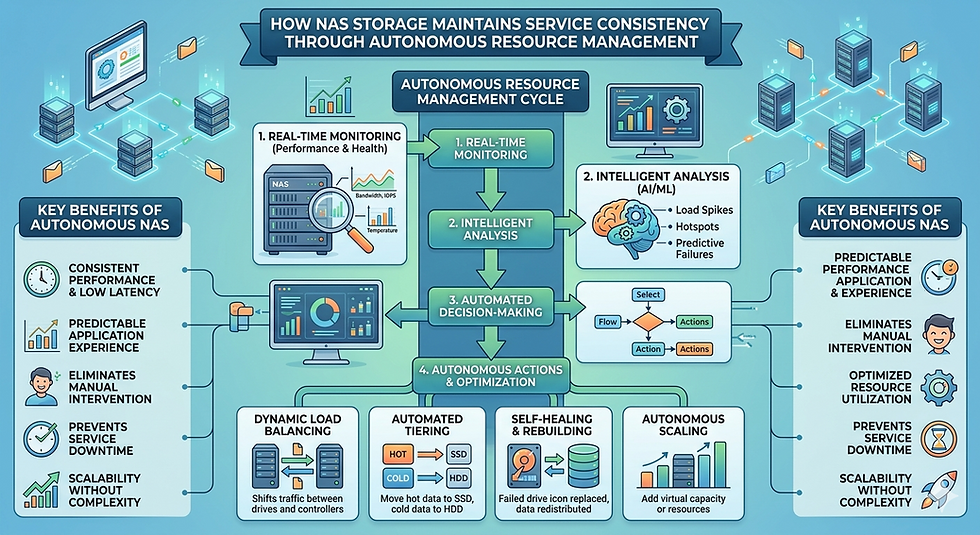
Today, we are witnessing the transformation of NAS into truly active infrastructure. The line between "compute" (where processing happens) and "storage" (where data lives) is blurring.
Modern NAS operating systems are becoming sophisticated platforms in their own right. It is now common to see containerization (like Docker) supported directly on the storage appliance. This means applications can run right next to the data they need to process, drastically reducing latency.
For example, instead of moving a massive video file across the network to a server for transcoding, the NAS itself can run the transcoding application. Or, a Network Attached Storage system collecting video surveillance footage can run AI algorithms locally to tag events in real-time before the data ever leaves the box.
This shift has immense implications for:
Edge Computing: In remote locations with limited bandwidth, having a NAS that can process data locally and only send the results back to the cloud is a game-changer.
Cloud Integration: Modern NAS isn't an island. It acts as a gateway, intelligently tiering cold data to public clouds (like AWS or Azure) while keeping hot, active data on fast local flash storage.
Cybersecurity: Storage is now an active participant in defense. Modern systems use machine learning to detect ransomware patterns—such as a sudden spike in file encryptions—and can automatically lock down accounts or create immutable snapshots to ensure recovery.
Why Your Storage Strategy Matters More Than Ever?
The evolution from passive to active is not just a technical upgrade; it is a strategic imperative. If your organization treats storage as a commodity purchase based solely on the lowest price per terabyte, you are likely investing in a bottleneck.
Investing in modern storage infrastructure means investing in the speed of your business. Whether it is a Scale out NAS cluster to support your growing media library or an iSCSI NAS solution to power your virtualization farm, the hardware you choose dictates how quickly you can pivot, analyze, and react.
We have moved past the age of digital filing cabinets. Your data is alive, constantly moving, and growing. Your infrastructure needs to be just as dynamic.


Comments