Why Are NAS Storage Solutions Becoming a Core Layer of Ransomware Defense?
- Mary J. Williams
- Jan 7
- 4 min read

Ransomware attacks are no longer a question of "if" but "when" for modern businesses. As cybercriminals evolve their tactics, moving from simple encryption to sophisticated double-extortion schemes, the traditional perimeter defenses—firewalls, antivirus software, and intrusion detection systems—are struggling to keep up. When the perimeter is breached, the last line of defense is your data architecture itself.
This shift in the threat landscape has forced IT leaders to re-evaluate how they store and protect critical data. Network Attached Storage (NAS) has long been a staple for file sharing and centralized storage, but its role is rapidly expanding. Today, advanced NAS storage solutions are emerging as a critical component of a resilient cybersecurity strategy, offering features designed specifically to thwart ransomware and ensure business continuity.

The Evolution of the Ransomware Threat
To understand why storage architecture matters, we first need to look at how ransomware operates today. Early variants simply encrypted files on a local machine. If you had a backup, you could wipe the machine and restore the data.
Modern ransomware is far more insidious. It actively hunts for backups to encrypt or delete them, ensuring the victim has no choice but to pay. It traverses networks, seeking out shared drives and central repositories. This is where a standard file server can become a liability, and where a hardened NAS system becomes a shield.
Organizations are realizing that data protection cannot be an afterthought; it must be intrinsic to the NAS storage solutions themselves.
How NAS Storage Solutions Fortify Defense?
A NAS is not just a hard drive plugged into the network; it is a sophisticated, purpose-built server dedicated to data storage. Modern NAS devices operate on specialized operating systems that allow for robust security configurations far beyond what a general-purpose Windows file server typically offers.
1. Immutable Snapshots
One of the most powerful features of enterprise-grade NAS storage solutions is the ability to create immutable snapshots. A snapshot is a point-in-time copy of the file system. "Immutable" means that once this snapshot is taken, it cannot be modified, encrypted, or deleted—even by an administrator—for a set period.
If a ransomware attack encrypts your active files, you don't need to negotiate with criminals. You simply roll back the storage volume to the snapshot taken an hour before the infection occurred. Because the snapshot is immutable, the ransomware cannot encrypt it, rendering the attack ineffective.
2. The Air-Gap Strategy
The concept of an "air gap"—keeping a copy of data physically or logically disconnected from the main network—is a gold standard in backup strategies. While true physical air-gapping (like tape backups stored offsite) is secure, it is slow to restore.
Modern NAS systems often feature logical air-gapping capabilities. This involves a secondary NAS unit that remains offline and disconnected from the network, only waking up briefly to replicate data from the primary unit before severing the connection again. This minimizes the attack surface, giving ransomware virtually no window of opportunity to infect the backup data.
3. Granular Access Controls and WORM
Write Once, Read Many (WORM) technology prevents data from being overwritten or modified. This is crucial for compliance but also excellent for ransomware defense. By storing critical archives on WORM-compliant volumes within a NAS system, businesses ensure the integrity of that data.
Furthermore, NAS operating systems usually run on Linux-based or proprietary kernels, which are less susceptible to the Windows-targeting malware that constitutes the majority of ransomware strains. This heterogeneity in the IT environment adds a natural layer of resistance.
The Role of ISCSI NAS in Recovery Speed
Prevention is half the battle; the other half is recovery. When an attack occurs, downtime is the enemy. Every minute a business is offline costs money. This is where the performance of the storage interface becomes vital.
An iSCSI NAS (Internet Small Computer Systems Interface) allows storage to be accessed over standard IP networks as if it were a local disk. Unlike standard file-level storage, iSCSI creates block-level storage. This is particularly important for restoring heavy workloads like databases or virtual machine (VM) images.
If a ransomware attack corrupts a virtual server, an iSCSI NAS target containing the backup images allows IT teams to mount that backup and boot the VM directly from the NAS almost instantly. This capability drastically reduces Recovery Time Objectives (RTO), turning a potential week-long outage into a minor disruption.
Integrating NAS into a Zero Trust Architecture
The "Zero Trust" security model operates on the principle of "never trust, always verify." NAS storage solutions fit perfectly into this framework.
Modern NAS appliances support Multi-Factor Authentication (MFA) for administrative access. Even if a hacker compromises an admin password through a phishing attack, they cannot log in to the storage array to delete backups without the second factor.
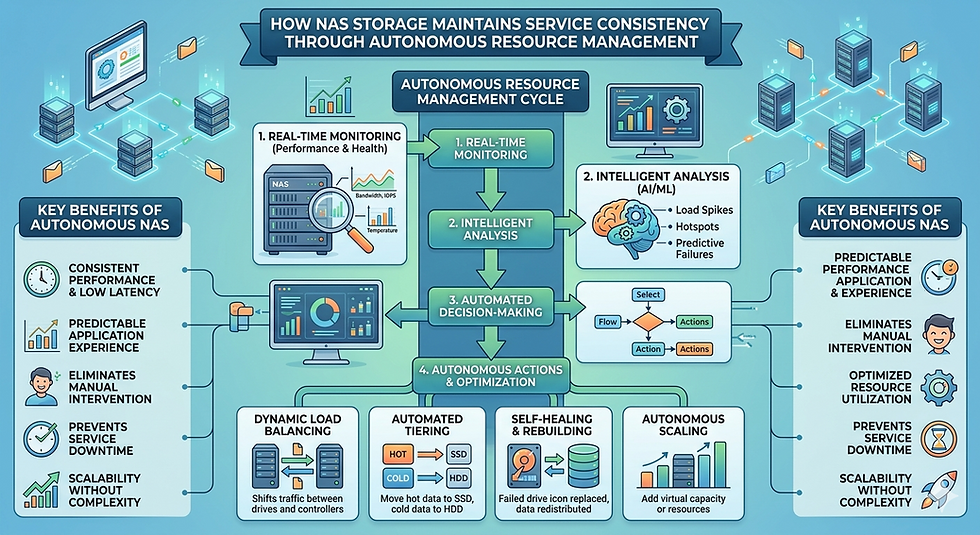
Additionally, sophisticated NAS units now include AI-driven anomaly detection. These systems monitor file access patterns in real-time. If the NAS detects a sudden spike in file modifications (indicative of a massive encryption process) or unusual access times, it can automatically sever the connection to the infected user account and alert administrators. This proactive defense stops the spread of ransomware before it engulfs the entire network.
Choosing the Right NAS for Security
Not all storage devices are created equal. When selecting a NAS for ransomware defense, organizations should look for specific capabilities:
Snapshot Technology: Ensure the system supports frequent, lightweight, and immutable snapshots.
Operating System: Look for hardened, secure OS options that support containerization and advanced encryption.
Performance: Evaluate the throughput for both backup ingestion and restoration.
Vendor Support: Regular firmware updates are essential to patch vulnerabilities.
Investing in a robust NAS is often more cost-effective than paying a ransom or suffering through weeks of downtime. It shifts the power dynamic from the attacker back to the business owner.
A Final Layer of Resilience
Ransomware developers are constantly looking for new weaknesses, but a solid data foundation makes their job significantly harder. By deploying secure NAS storage solutions, utilizing immutable backups, and leveraging high-speed iSCSI NAS protocols for recovery, businesses create a defense-in-depth strategy.
Technology alone cannot solve every security problem—employee training and network hygiene remain essential. However, when those outer defenses fail, your storage solution must be strong enough to stand on its own. A modern, secure NAS is no longer just a digital filing cabinet; it is the vault that keeps the business alive.


Comments